



Net of Nature
Trails

Stage: Ojos Negros - Santa Eulalia







Description
- - - - - - - -
¡IMPORTANT WARNING! THE CURRENT STAGE, WHICH IS JUST UNDER 15 KM LONG, IS INCOMPLETE. IT WILL SOON BE POSSIBLE TO COVER IT IN ITS ENTIRETY FROM OJOS NEGROS (SIERRA MENERA MINES) TO THE OLD SANTA EULALIA STATION, AND YOU CAN FULLY ENJOY THIS BEAUTIFUL MINING AREA, WHERE THE RAILWAY LOADED WITH IRON ORE USED TO PASS
- - - - - - - -
The Sierra Menera mines: a place steeped in history.
A short and incomplete stage running for under 15 km, with a strong mining aspect. The route starts from the Sierra Menera mines, passing near various mining neighbourhoods, before giving you the chance to enjoy villages such as Villar del Salz and Peracense. The stage ends shortly after you see the impressive castle of Peracense, perched on the reddish rocky escarpments as if it were an illusion.
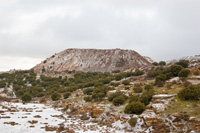
The stage begins in the Sierra Menera mines. Specifically, beside the two large hoppers that were used to load the ore into the wagons that headed for the Port of Sagunto where, after processing in the blast furnaces, they would begin their final journey across the Mediterranean Sea.
After leaving behind the rest area beside the mining hoppers, the journey begins like a steam locomotive which, after a little more than a kilometre, arrives at what is known as the Barrio del Hospital, one of the six miners’ villages that were built around the mines as the workers’ place of residence. In this case, as its name suggests, this is where the medical services were located, including radiology services and the doctor’s residence, among others.
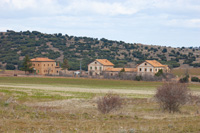
To the traveller’s right, there are real mountains of ore waste produced over the years when these mines were worked, providing a unique landscape that stands in stark contrast with the silence and calm that pervades today.
When you reach the second kilometre in this stage, you can spot on the left what was and still is the largest of the villages built to house the workers of the Sierra Menera mine. Known as Barrio del Centro, it had various services, including a church, a casino, a commissary and a swimming pool. It is currently inhabited with a hostel that is open to the public that pays homage to the mine and the mining railway with a monument to the railway between Ojos Negros and Sagunto and an original locomotive (Orconera) including a hopper wagon.
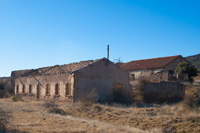
On returning to the itinerary, and after passing kilometre point 4, you will reach the old Ojos Negros station, beside which you will find the old train depot and a new mining village, this time in a state of ruin and abandonment. In the same direction, on leaving the route of the Nature Trail, just on the other side of the TE-V-9025 road, you will see what was once the luxurious complex known as the Management House of the Compañía Minera de Sierra Menera (Management House of the Sierra Menera Mining Company). Here were located the dwellings and offices of the most senior officials: engineers, administrator, etc.
Returning to the Nature Trail, the stands of holm oaks (Quercus ilex) alternate with rain-fed cereal crops and, after kilometre six of the stage, hikers will reach the interpretative panel that invites them to visit the village of Villar del Salz.
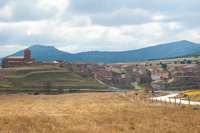
In this village you can enjoy two hermitages: Santa Águeda and Santa Bárbara, (both of which are outside the village itself) as well as the church of the Assumption and, lastly, its spectacular four-storey council building. Built in the 19th century, it is topped by a clock and bell and has the peculiarity of being the narrowest in Teruel.
Returning to the Nature Trail route, cross the TE-V-9023 road over an elevated bridge. Little by little, you will leave behind the panoramic views of Villar del Salz, while the natural vegetation gradually takes over from crops, especially on the right of the route, where the steepness of the relief has prevented the land from being tilled.
With continuous and easy pedalling for those who wish to cycle the route, you will reach kilometre point 12 and the village of Peracense will come into view. Metres beyond this, there is an interpretative panel at the road junction, a clear invitation to the traveller to visit the aforementioned village.
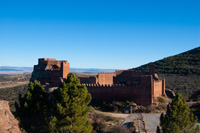
Peracense is on the left of the old railway route. It is a particularly beautiful village with the church of San Pedro, where both the church and some of the houses were built with a reddish sandstone that is very abundant in the area and which lends all the buildings a characteristic tone. But without a doubt, the best example of architecture made with this unique type of stone is Peracense Castle, which almost blends in with the stone of the land itself. Located at the right of the Nature Trail, it is recommended that you visit it before continuing your adventure.
It’s time to continue. Cyclists will continue on their way with the beauty of the red sandstone, which is so abundant in this area, etched on their retina, and it will have become part of that imaginary virtual rucksack where every traveller keeps their memories of every Nature Trail.
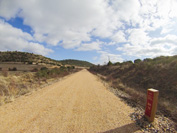
Metres after passing kilometre point 14, you will reach the typical signage that identifies the Caminos Naturales (Nature Trails) brand, which indicates to travellers that this is the provisional end of the Nature Trail, as the fitted-out route currently ends at this point. The remainder of the route will soon be upgraded until it connects with the next fully-equipped stage at the former Santa Eulalia station.
Until then, as indicated by another sign at the same point, travellers can continue under their own steam to the old Santa Eulalia station, taking extreme precautions since this option is off the Nature Trail route. As the signs warn, it is 16.5 km from here to the old Santa Eulalia station, on roads and paths shared with motor vehicles, so cyclists must plan their route with all the information supplied by Caminos Naturales and their own circumstances.
Managing Entities
Links of Interest
Puntos de interés
Culture
- Santa Eulalia Station
- Casa-Gerencia Compañía Minera Sierra Menera
- Santa águeda hermitage
- San Ginés hermitage
- Castillo de Peracense
- Santa Bárbara hermitage
- Old barrio minero
Geology
Infrastructure
Municipality
- Santa Eulalia
- Barrio Centro Minera Sierra Menera
- Old Barrio Hospital (mining)
- Peracense
- Villar del Salz
- Ojos Negros
Hostel
Vegetation
Profile
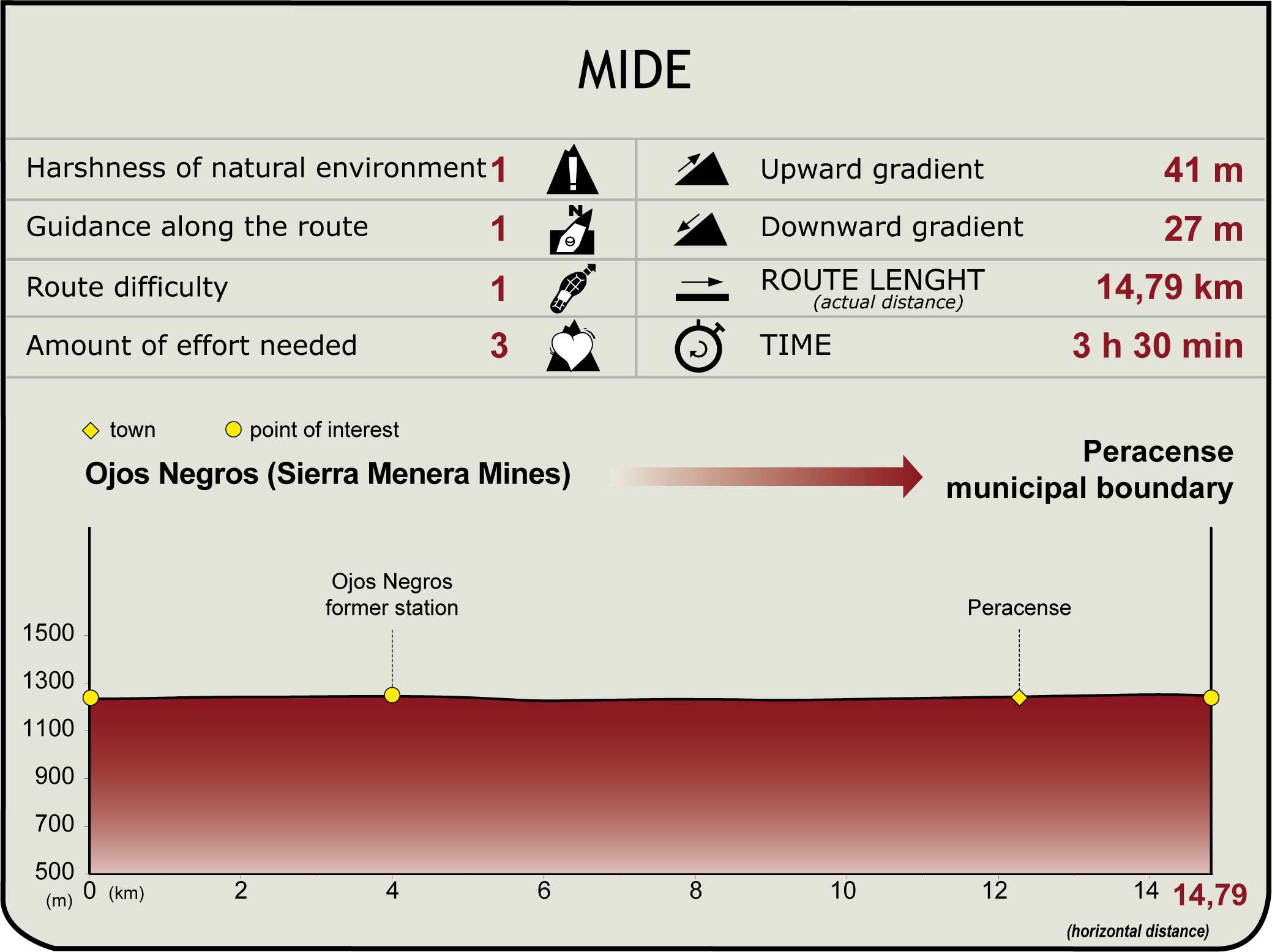
 Harshness of natural environment
- 1. The environment is not risk-free
- 2. There are more than one risk factors
- 3. There are various risk factors
- 4. There are quite a lot of risk factors
- 5. There are many risk factors
 Guidance along the route
- 1. Well defined trails and crossings
- 2. There is a clearly marked trail and signage
- 3. Requires the identification of geographic features and cardinal points
- 4. Requires off-path navigation
- 5. The trail is interrupted by obstacles that have to be gone around
 Route difficulty
- 1. Walking on a flat surface
- 2. Trails with different types of path
- 3. Walking on stepped paths or irregular terrain
- 4. The use of hands or jumping over the terrain is necessary
- 5. The use of hands is required to progress
 Amount of effort needed
- 1. Up to 1 hour of continuous walking
- 2. Between 1 and 3 hours of continuous walking
- 3. Between 3 and 6 hours of continuous walking
- 4. Between 6 and 10 hours of actual walking
- 5. More than 10 hours of continuous walking
(Calculated according to the MIDE criteria for an average excursionist with a light load)
Highlights
Peracense Castle
An imposing castle perched on the escarpments of the reddish rock formations. This red sandstone is also the main material used to build it. This enclave has been inhabited since the Bronze Age and later, in the Muslim period, according to various findings from archaeological excavations undertaken in 1988. The greatest expansion of the castle occurred in the 14th century, when it became a strategic point between the kingdoms of Aragon and Castile. In the 19th century, the fortress was embroiled in various military conflicts and even acted as a prison for a time.
After a period of abandonment, restoration work began in 1987 to arrest the deterioration of the whole complex and to enhance it in cultural and tourist terms. Since 2014, all visitors have had the opportunity to enjoy life-size reproductions of medieval siege weapons in the castle’s two courtyards. The castle is included as an Asset of Cultural Interest in the province of Teruel.
Multimedia


Downloads

GPS Downloads


Documents

Cyclability
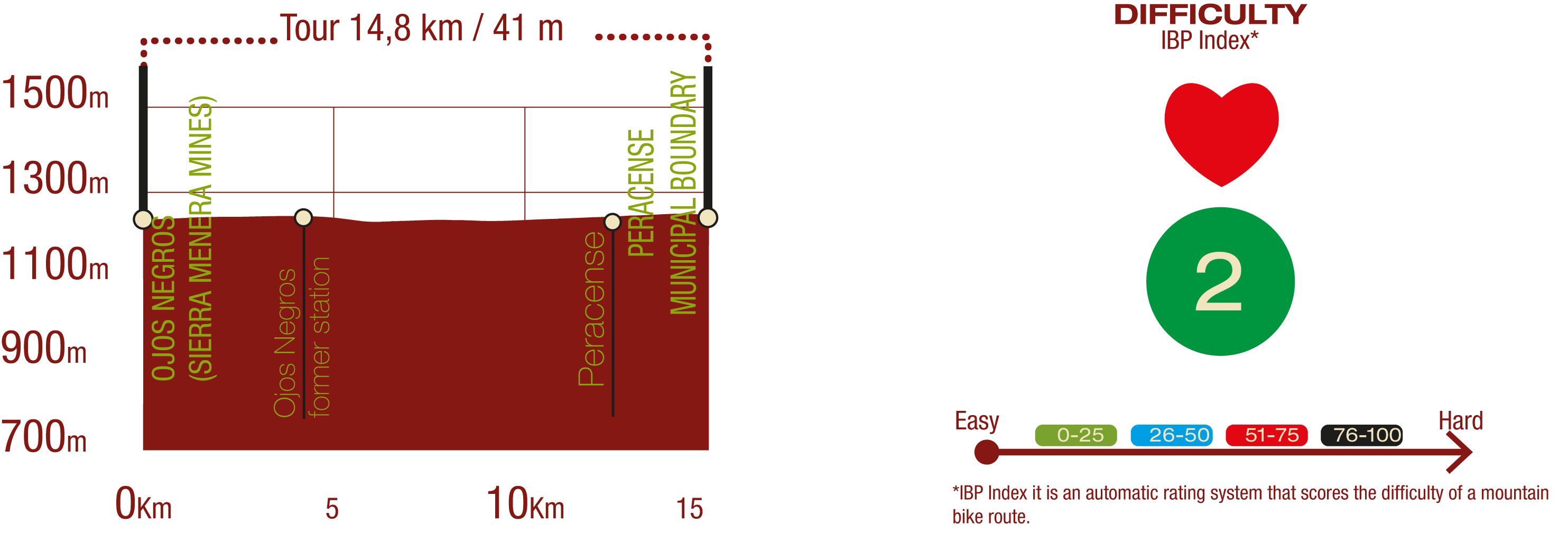
PROFILE & DIFFICULTY
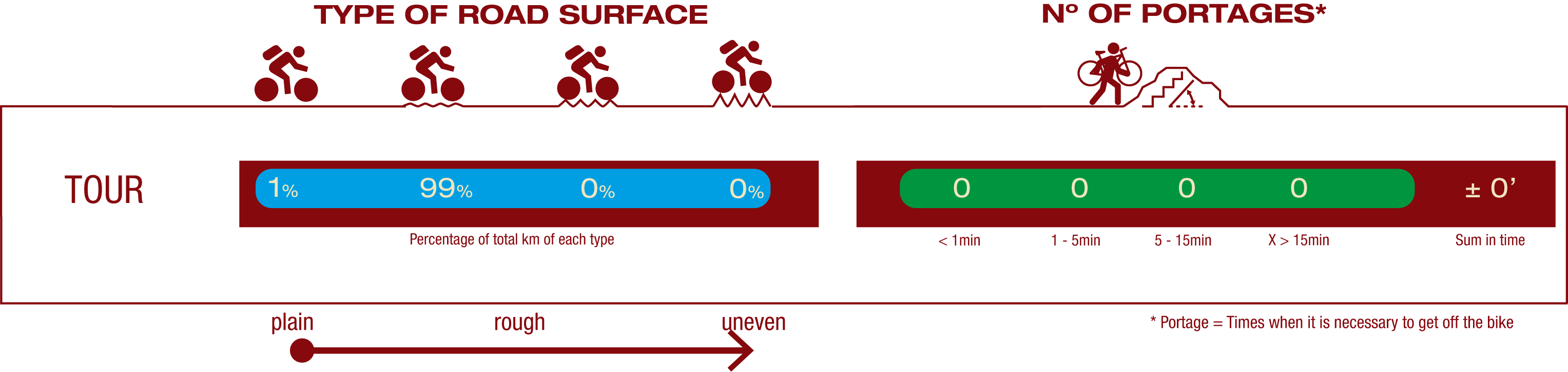
TYPE OF ROAD & PORTAGES
TEST

SAFETY RECOMMENDATIONS
- Caution when crossing roads and dirt roads.
GENERAL RECOMMENDATIONS
- Find out about the technical aspects of the route and the weather on the day.
- Take care of the environment. Take care not to disturb animals or damage vegetation. Respect private areas.
- You must give priority to pedestrians and comply with general traffic rules.
- The environment in which you will be riding is open, free to move around and an area where many activities are carried out (sporting, forestry, livestock and agricultural activities). Always have an understanding, prudent, responsible and respectful attitude.