
Puntos de Interés

Municipality
Poza de la Sal
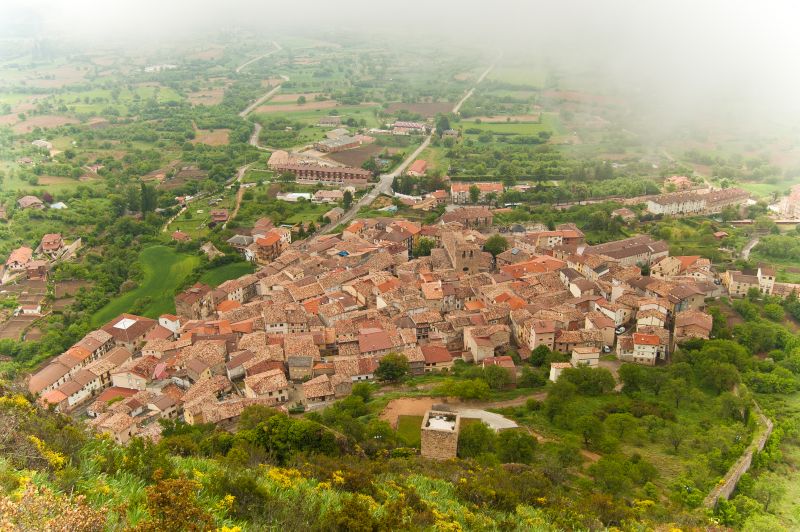
Poza de la Sal is a municipality in Burgos belonging to the comarca of La Bureba, at the foot of the Páramo de Masa. This location on the slopes of the limestone massif that forms the plateau, gives the town an excellent vantage point for its surroundings, as well as a privileged natural landscape, with the salt flats and surrounding mountain ranges standing out. One Spain’s most famous naturalists was born in this natural enclave: Félix Rodríguez de la Fuente.
The history of Poza de la Sal has always been closely linked to its salt mines throughout all periods of history. Thus, it was the determining factor for the existence of a continuous human settlement at this location. It is believed that it was in the Neolithic period that the method of "salt creation" was first used (as previously they simply collected the naturally occurring crystals). Possible Neolithic and Chalcolithic remains were found at a dig in 1999, and at another site, which confirms the presence of humans in the Middle Bronze Age. Subsequently about two kilometres from the centre of the municipality, the Villa Salionca or Salionica was found, an Autrigones settlement which, with the arrival of the Roman Empire, would become Flavia Augusta, of which some vestiges remained, including the aqueduct, the Roman road and some oikomorphic urns. The Roman period saw a boom in salt production activity.
After the Christian reconquest of the area, a Benedictine Monastery of Santos Justo y Pastor was created, under the control of San Pedro de Cardeña de Burgos from the 10th to the 13th century. The two churches and a series of protective barriers were the origin what became the current town. It is also worth noting that the exploitation of the salt mines was governed by San Pedro de Cardeña in the 10th, 11th and 12th centuries, later passing into the hands of San Salvador de Oña in 1011. It was also overseen by Las Huelgas de Burgos, the Fernán González family and the kings of Castile from Alfonso VIII onwards.
Poza de la Sal boasts a wealth of architectural heritage. Among its religious buildings, the Church of San Cosme and San Damián, declared a Historic-Artistic Monument, stands out. It was built in the 13th century and has been reformed on several occasions throughout its history. The sanctuary of Nuestra Señora de Pedrajas, a small shrine with a single nave and a three-span roof, is also worth a visit, as is the Convent of San Bernardo de Siena, founded in the 15th century but abandoned since the confiscations of the 19th century. With regard to its civil architecture, the castle strategically located on an imposing rocky massif, the Palace of the Marqueses de Poza, to which some ruins located on the eastern slope of the castle belong, and the old wall that protected the town stand out.
In terms of local festivals, the celebration of San Blas stands out, which includes the Danza del Desjarrete. Other important occasions in the municipality are the processions of San Marcos and the Virgen de Pedrajas, the country produce auction in San Isidro, the salt workers' festival in honour of Santa María Magdalena, as well as the patron saint festivities in honour of San Cosme and San Damián, and the celebration in honour of Santa Cecilia, patron saint of music.