


Puntos de Interés

Culture
Daroca walls
The origins of the municipality of Daroca lie in an ancient Muslim fortified complex from the 9th century, whose walls are undoubtedly the element that best characterises the village. Since it was built, the defensive enclosure has been extended, modified and rebuilt many times, meaning that experts are unable to date its construction precisely, except for the most outstanding elements. However, it is clear that they were built between the 13th and 16th centuries.
This building was therefore built over many years using many different types of construction elements, and thus lacks any structural unity, as found in other similar enclosures such as those in Ávila and Lugo. But, far from detracting from its interest, by not being characterised by any element in particular, it is much more complex and curious. The materials used to build it include reddish and greyish mortar, masonry, brick with Mudejar tracery and ashlar stone, although the latter is reserved for the main walls and towers.
In their Muslim past, the walls enclosed the citadel of the city, what is known today as the Castillo Mayor, from where they climbed to the summit of the San Cristóbal hill and then descended to the Tres Guitarros wall, crossing the ravines of La Grajera and Valcaliente. As a Christian city, from 1142, the city witnessed significant growth that made it necessary to expand the enclosure to concentrate inside it the new neighbourhoods that has been built outside its walls. Thus, the wall was extended, connecting the San Cristóbal and San Jorge hills, with two impressive gates, the Alta and the Baja, one of the most beautiful in Aragon.
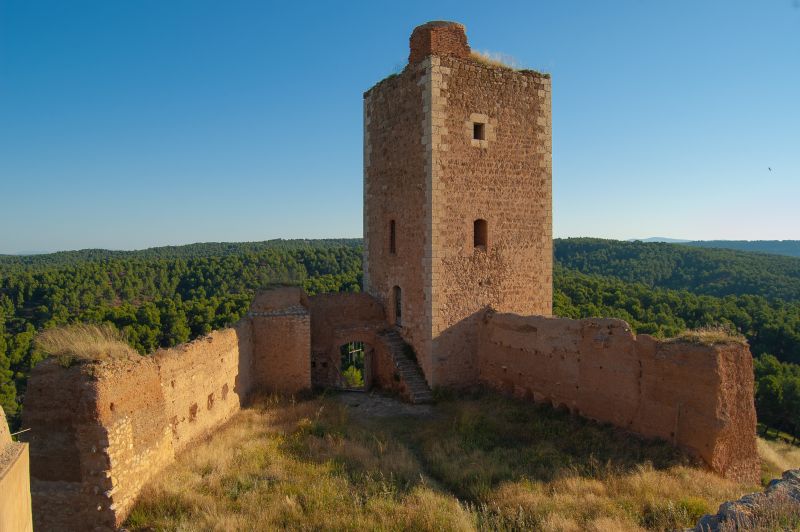
The Daroca walls were then as we know them today, consisting of 116 turrets arranged around their more than 4 km length. Their purposes, besides defence, was to unitte the three fortified sites in the city: the Castillo Mayor, the San Jorge or Jewish Quarter Castle and the San Cristóbal Castlel, known as the Torre del Andador. Today, only fourteen turrets and two fortified defensive gates remain standing.
Among these buildings, the two aforementioned defensive gates stand out: the Puerta Baja (Lower Gate), which has two quadrangular turrets and which was restored in the 16th century, and the Puerta Alta (Upper Gate), which was transformed in the 17th century. Both guard the two main entrances to the city. There are also two other gates in the town, the Puerta de Valencia and the Puerta de San Martín de la Parra.
All of them are still in good condition. The same cannot be said of the walls, on which many sections have disappeared or are in ruins.
Otros puntos de interés
- El Carmen hermitage
- Road labourers' house
- San Bartolomé hermitage
- Ermita de San Francisco
- San Pedro Martir hermitage
- San Roque hermitage
- Virgen del Buen Reposo hermitage
- Virgen del rosario hermitage
- Virgen del Rosario hermitage
- Virgen de los Dolores hermitage
- Roman bridge
- Torre de Nuestra Señora del Pilar