


Puntos de Interés

Hydrography
River Jiloca
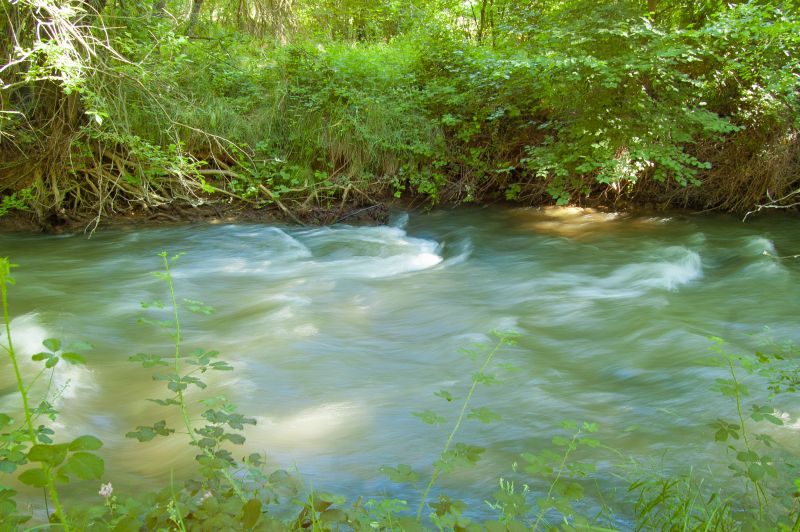
The River Jiloca is one of the most unique rivers in Aragon due to much of its flow being of underground origin. Examples of this curiosity are called “Ojos del Jiloca,” which are on the plains of Monreal del Campo, Caminreal and Fuentes Claras.
Although its source has long been identified at Fuente de Cella (Teruel), which is considered the largest artisan well in Europe, it has been shown that this section as far as Monreal is really a canal built in the 18th century, when the lagoons of the Cañizar de Villarquemado and Cañizar de Alba were drained. According to a study conducted in 2003, the true source of the Jiloca is in an area known as the “Ojos de Monreal del Campo”.
This 126-kilometre river flows through the provinces of Teruel and Zaragoza and runs through the districts of Comunidad de Teruel, Jiloca, Campo de Daroca and Comunidad de Calatayud. Its flow rate in Calatayud is 293 hm³/year, but, given its location, it is highly irregular, with a very marked low water level and high-water levels in autumn and spring.
After leaving Monreal, it continues towards Caminreal and Fuentes Claras, where it accumulates the water from the ravines during the storm season, and reaches Luco de Jiloca, where it receives the waters of the Pancrudo, its main tributary.
The river enters the province of Zaragoza at Villanueva de Jiloca, opening its course upon reaching Daroca, excavating soft Tertiary materials, before becoming embedded in the Palaeozoic materials at Manchones, Murero and Villafeliche. Once it has left Maluenda and Calatayud it empties into the river Jalón, its largest tributary.
It is noteworthy that the entire Jiloca district is linked by the river and the villages it flows through form an interesting water route that is popular with tourists. Furthermore, since time immemorial it has been used as a means of communication between the Meseta, the Ebro Valley and Levante, attested by the many bridges dotted along the course of the river, some dating from Roman times, such as the bridge at Luco de Jiloca or the one at Calamocha.
One should also remember that the Cid Campeador used this route on his way to Valencia, and the Christians expanded southwards through the Jiloca Valley, leaving Mudejar architecture as a testament to this.
As for the riverside vegetation, it essentially consists of poplars, many of which are ancient trees, which are a basic element of thew Jiloca district, and is one of the elements of its natural and cultural identity. There are also many cherry trees and almond trees, especially between the municipalities of Luco and San Martín del Río.