

Puntos de Interés

Infrastructure
Old Dosante - Cidad station

Located at the 365.7 kilometre point of the Santander-Mediterranean Sea railway line, at an altitude of 696.6 m, is the old Cidad-Dosante or Dosante-Cidad station, as it was also known.
The complex was built in the Spanish municipality of Merindad de Valdeporres, in the province of Burgos, by the Compañía del Ferrocarril Santander-Mediterráneo, and commissioned at the end of 1930, coinciding with the opening of the Trespaderne-Cidad section.
At that time, much of the line was operational, providing both passenger and freight services. However, the planned extension to Santander never materialised, and Cidad-Dosante became the station where the line ended.
In 1938 a junction track was added to facilitate transfers with La Robla railway, which had a station nearby. With the nationalisation of the Iberian gauge railways in 1941, the facilities were taken over by RENFE and, from 1966, passenger services on the Trespaderne-Cidad section stopped at Villarcayo station. This marked the beginning of Cidad-Dosante's decline. In this context, the Santelices-Cidad section would become inactive.
The railway line that departed from Calatayud (Zaragoza) operated from 1930 until 1984, without ever reaching its final destination in Santander due to the difficulty of the section through the mountains of the Cantabrian divide, which was never completed. Although the Cidad-Dosante station was located, as mentioned above, at the 365.7 kilometre point, the track actually ended 800 m further on, with a total length of 366.547 km.
In 2003 the track was dismantled, and the area was gradually reclaimed by nature, although there are still some interesting remains of this end point where the Santander-Mediterranean Sea railway connected with La Robla railway, requiring passengers to change trains if they wished to continue their journey.

Despite the decrepit state of the complex, the passenger and freight buildings are still standing, along with the remains of a service hut. To the right of the tracks are the remains of a small hut with a large window, which used to be the weighing house. Inside, the machine that indicated the weight on the outer platform is still in place, albeit in a very deteriorated state. Although the tracks have been removed in this section, rails can still be seen in some sections indicating the route of the train.
Near the station, some 800 m away, is the retaining wall that protected the final section of the platform, along with the ruins of a small building that served as a dwelling for the railway agent. Here, passengers on the Santander-Mediterranean Sea route could get tickets to continue their journey at La Robla. Both railways converged at this point, with common facilities and ramps built to facilitate the transfer of goods and passengers between the lines of different height and gauge.
The history of the Santander-Mediterranean Sea railway line is one of frustrated attempts to reach its final destination. Despite the efforts, the La Engaña tunnel, a complicated work that required drilling almost seven kilometres across the divide between Burgos and Cantabria, was never completed. The line was closed in 1985 due to its lack of profitability, and has since been largely dismantled.
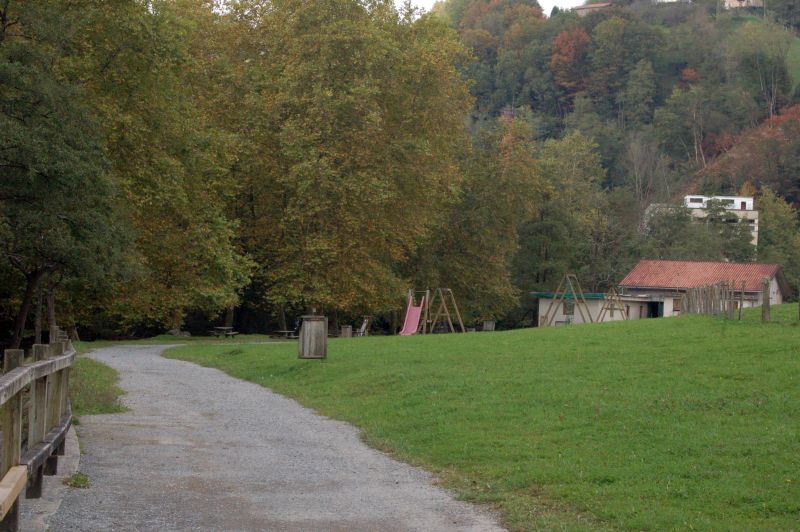
At present, the facilities are abandoned and semi-dismantled, but there is a rest area nearby where visitors can regain their strength and take a break. It has several tables and benches, as well as an information panel corresponding to the Santander-Mediterranean Sea Nature Trail.
Otros puntos de interés
- Bilbao - La Robla mining railway
- Cidad Tunnel
- Viaduct over the river Nela
- Viaduct over the river Nela
- Viaduct over the river Nela
- Puentedey tunnel
- Viaduct over the river Nela
- Old Brizuela station
- Viaduct over the river Nela
- Old Escaño halt
- Viaduct over the river Nela
- Viaduct over the river Nela
- Viaduct over the river Nela
- Old Horna-Villarcayo Station
- Viaduct over the river Nela
- Old Medina de Pomar station