


Puntos de Interés

Culture
San Mamés hermitage
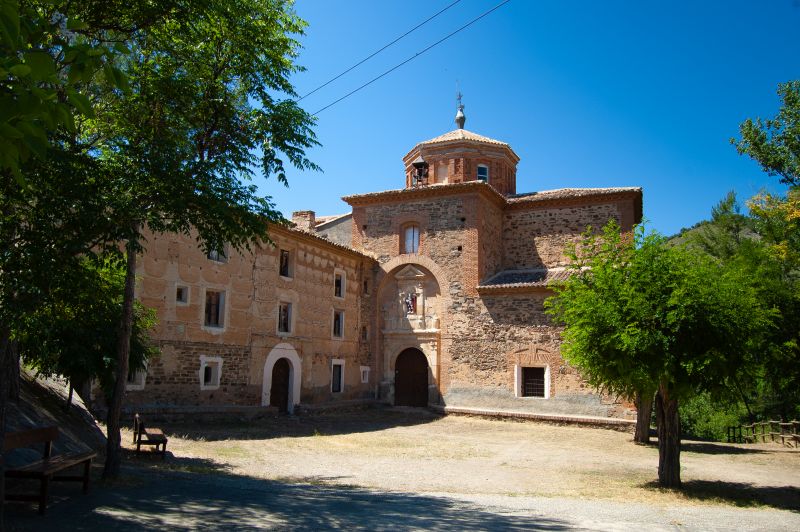
According to legend, in 1600 San Mamés appeared to the parish priest of Murero bringing an important message: to rebuild the village’s hermitage. And so it was that in the orchard, on the opposite side of the River Jiloca, the San Mamés hermitage was built, a temple in the Baroque style that overlooks the road leading to Altea.
It is a deeply devotional site for the residents of the village of Murero, the epicentre of various cultural traditions that have remained intact to the present day.
The complex consists of an “L”-shaped building made up of the church building and the hostelry, both of which date to the 18th century, as well as the hermit’s dwelling.
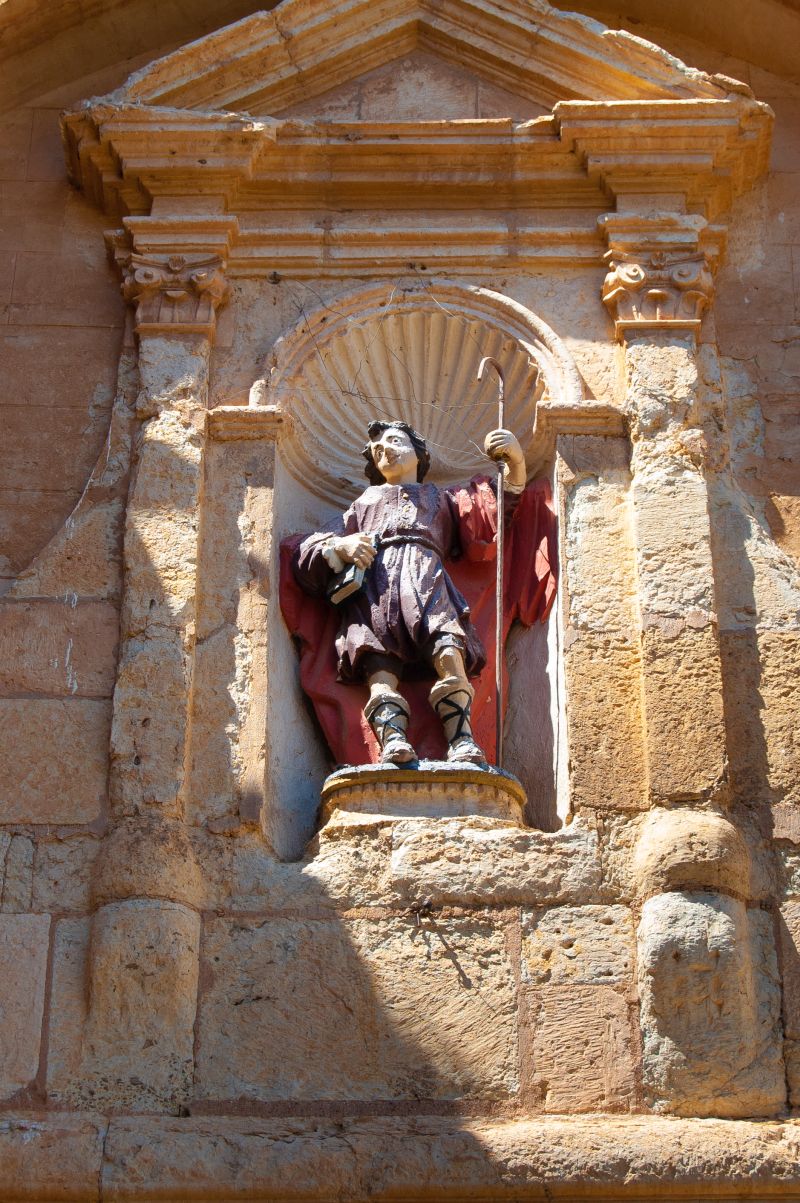
This hermitage, built in sober masonry, is striking thanks to its large dimensions and the brick details in the corners and the outline of the bays. The church is accessed through an elaborate stone doorway comprising two sections under a semicircular brick arch. The first of these bodies, on the lower floor, is an arch flanked by two Ionic-style pilasters that recall the classical mode. The second is an alcove with composite pilasters and a triangular pediment containing a neoclassical image of San Mamés as a child.
The absence of a tower means that the octagonal dome above the transept is the most prominent feature that can be seen from the exterior.
The space used for the hermitage consists of a large rectangular floor plan. It has a single nave divided into three sections topped by half-barrel vaults with lunettes, as well as the presbytery and the two arms of the transept, the latter having an eight-section dome with lunettes on pendentives. The last section of the central nave contains the choir, which is supported by a carpanel arch, and the lateral aisles, which are in turn divided into two sections with groin vaults.
For their part, the sacristies, situated on either side of the chancel, are enclosed with lunette vaults and flat domes on pendentives. The whole complex is plastered and ornamented and was painted in 1863 by Santiago González Pascual, according to various inscriptions found in the grounds.
The church is home to some artistic gems such as its main altarpiece, dating from the latter half of the 18th century, which has gilded masonry, rocaille adornment and polychrome sculptures. Another highlight is the altarpiece with eight mysteries of the Rosary in polychrome relief, featuring the image of the Virgin in the middle of the chapel of the Virgen del Rosario, on the left side of the Gospel.
In the central aisle, inside a small alcove, there is a 17th century figure of San Mamés, and above it, a relief depicting the saint’s appearance to Cristobal Aguarón; on either side it shows the figures of a pope and a bishop, believed to be San Gregorio Magno and San Gregorio Nacianceno.
Numerous votive offerings are housed in the hermitage, including a scale which, according to tradition, was used to weigh children, such that their weight was donated in wheat for the upkeep of the hermitage.
Attached to the hermitage is the auxiliary building for pilgrimages, which was formerly the hostelry. It is compact in appearance, three storeys high, and of great interest due to its use of traditional solutions such as rammed-earth walls with whitewashed caissons and plaster cladding. The semicircular doorway and the remaining openings are whitewashed. The interior of the building is surprisingly well preserved, as seen in the floors, woodwork and unique elements such as the cadiera, a traditional wooden bench with armrests.
On 17 August, the feast of San Mamés and the Virgen del Rosario, all the residents of Murero go on pilgrimage to this hermitage, and the songs and dances they perform are worth mentioning. This is the case of the San Mamés bolero, which is performed while facing the saint in direction contrary to the direction of the procession.