

Puntos de Interés

Vegetation
Black poplar (Populus nigra)
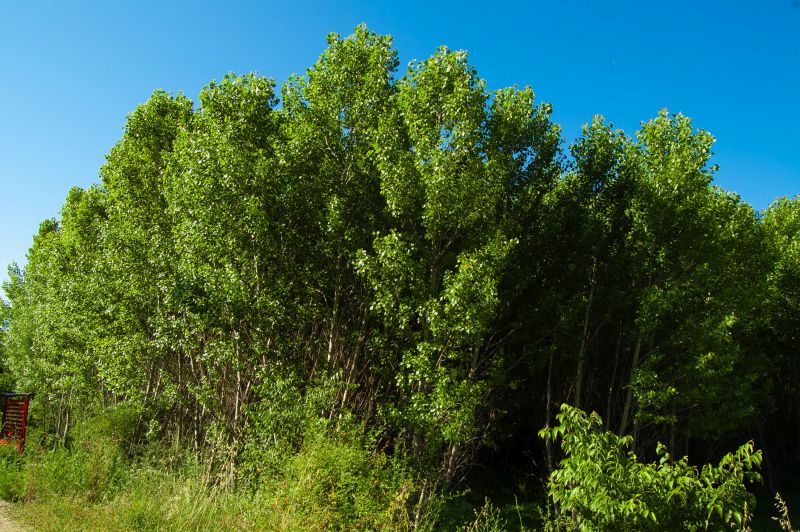
The scientific name of the black poplar, Populus nigra, translates as “tree of the people;” it is a species native to the Iberian Peninsula, and is very common in areas with a cold, dry climate, but with a gentle relief, as in the case of the Jiloca district. It is typically found on riverbanks, as well as in flooded areas, where it normally shares its environment with other species such as willows, ash and alders.
This tree species, which can grow up to 30 m high and which has a slender trunk, has always been found in the area along the banks of the river, and it has become a basic element of the landscape of the Jiloca district, where it is one of the elements of its natural and cultural identity.
It is also a very hardy species, which is capable of growing in all types of soil, and can even tolerate soils with a certain degree of salinity, which is why it can be found at sites ranging from sea level to 1,800 m above sea level.
As for its leaves, they are rhomboidal or triangular in shape, deciduous, single and alternate. Its fruits are capsule-shaped and open on ripening, releasing seeds encased in a cottony tissue, which is often mistaken for pollen, to aid their dispersal in the wind.
Its wood is highly prized because of its fast growth and is mainly used for pulp, paper, boards and light packaging. It has also been traditionally used for firewood, livestock fodder and construction beams. These uses have meant that a large network of poplar groves has been preserved today in the mountains of the Jiloca and Pancrudo basin, whose greenery and shade provide an oasis during the harsh summer months.
In short, the black poplar combines cultural and environmental attributes, being a component of the region’s natural heritage and an element of these territories’ identity.