


Net of Nature
Trails

Stage 8: Cabra Station – Navas del Selpillar Station – Lucena







Description
Lakes, canyons and caves amidst olive groves
This stage covers one of the most varied and complete sections of the Olive Oil Greenway Nature Trail. Along its 20.5 kilometres, the route links the towns of Cabra and Lucena, combining railway heritage with a landscape dominated by olive groves and vineyards, and an interesting sample of the cultural and craft legacy of the region.
The eighth stage of the Olive Oil Greenway Nature Trail is the longest of the route and begins at the old railway station in Cabra, now completely restored and equipped with a restaurant, a parking area for motorhomes, a children's area and a resting area, as well as an information point. The starting route of the Sima de Cabra Route, one of the most emblematic and representative trails of the Sierras Subbéticas Natural Park.
As soon as you leave the station, the path crosses the Góngora stream and passes by the Camino Natural calisthenics park and the start of the Puente de Jacas path. The route skirts the town of Cabra, passing next to the hospital, the Municipal Auditorium and the sports facilities, and crosses several roads by means of a bridge and a flyover. During this section, the route runs through olive groves, protected by wooden fences. Shortly after, it crosses an asphalted track next to an old railway construction and crosses the Huerta and Guadalazar Creeks.
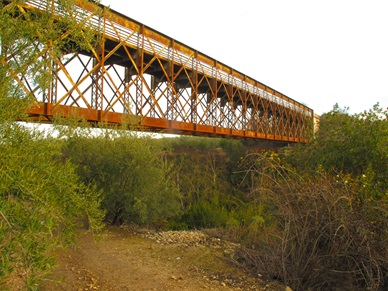
Just over six kilometres from the start, the stage reaches the Alamedal viaduct, which allows you to cross the Losilla stream. A few metres further on, the Casilla Cañada del Pastor sits near the town of Lucena. As you approach the town, the landscape dominated by olive groves gives way to the industrial estate, where the route crosses several junctions before reaching the station.
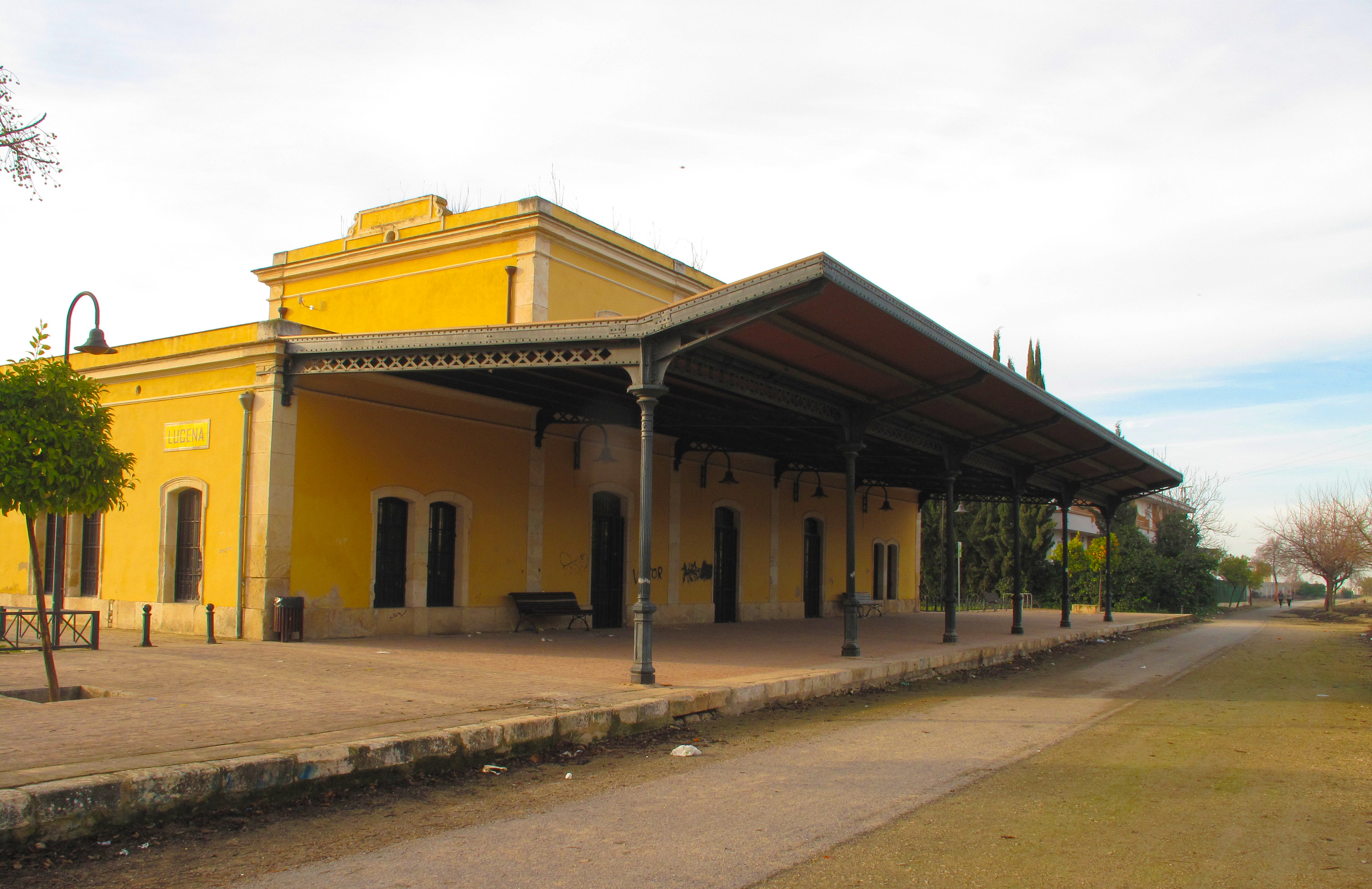
Lucena station, a second-class station, had a passenger building with three volumes: the left and right wings were identical, single-floor facilities and the central lounge had two floors, the first floor of which housed the station manager living quarters. It was notable for its V-shaped canopy, which was supported by cast-iron pillars and covered the entire length of the building. A few metres away from the passenger building and on the same side of the track, there were a couple of buildings that were used as cargo docks. In these roofed, open-plan halls there was a small office for the employee in charge of the delivery notes. On one side, cargo wagons were loaded or unloaded, while the other side was used for loading or unloading road vehicles. To protect cargo during loading and unloading operations, these buildings were designed with a gable roof terminating in side overhangs.
Nowadays, the main building has been transformed into the Crafts and Traditions Interpretation Centre, a space that pays homage to the customs and trades that have made the municipality famous: pottery, iron and bronze smithing and woodwork, as well as, of course, the olive oil culture, the fiestas and its popular folklore. On the same site, next to an old warehouse that has now been converted into a restaurant, you can also visit the Vintage Car Museum, which is open to the public at weekends.
In this final stretch, the landscape changes. The gently undulating terrain and the milder climate mark the entry in the vineyard country. Here the olive trees share the limelight with the vineyards where the grapes for the Montilla-Moriles wine, one of the most renowned products of the province of Córdoba, are produced. Thus, the route reaches the last stop of the stage, the Moriles-Horcajo railway station, in the hamlet of Las Navas del Selpillar (Lucena). This former halt, commissioned in 1891, has been converted into a museum, with a rest area, a parking area for motorhomes and a drinking fountain. Of particular note is the still preserved water supply tank for the steam locomotives: a cylindrical, sheet metal structure mounted on top of another masonry or brick structure.
As in the previous stages, this section of the Nature Trail links up with a wide network of routes that allow the traveller to discover the surroundings on foot, by bicycle or motor vehicle. These include those that run through the Sierras Subbéticas Natural Park, as well as interesting cultural proposals such as the Montilla-Moriles Wine Route, which has Lucena as one of its most important starting points.
Management entities
Sites of interest
Puntos de interés
Culture
- Casilla de guardabarrera
- Casilla de la Cañada del Pastor
- Casilla de obrero
- Estación de Lucena
- Estación de Cabra
Geology
Hydrography
Information
Infrastructure
Municipality
Hostel
Vegetation
Passport
Profile
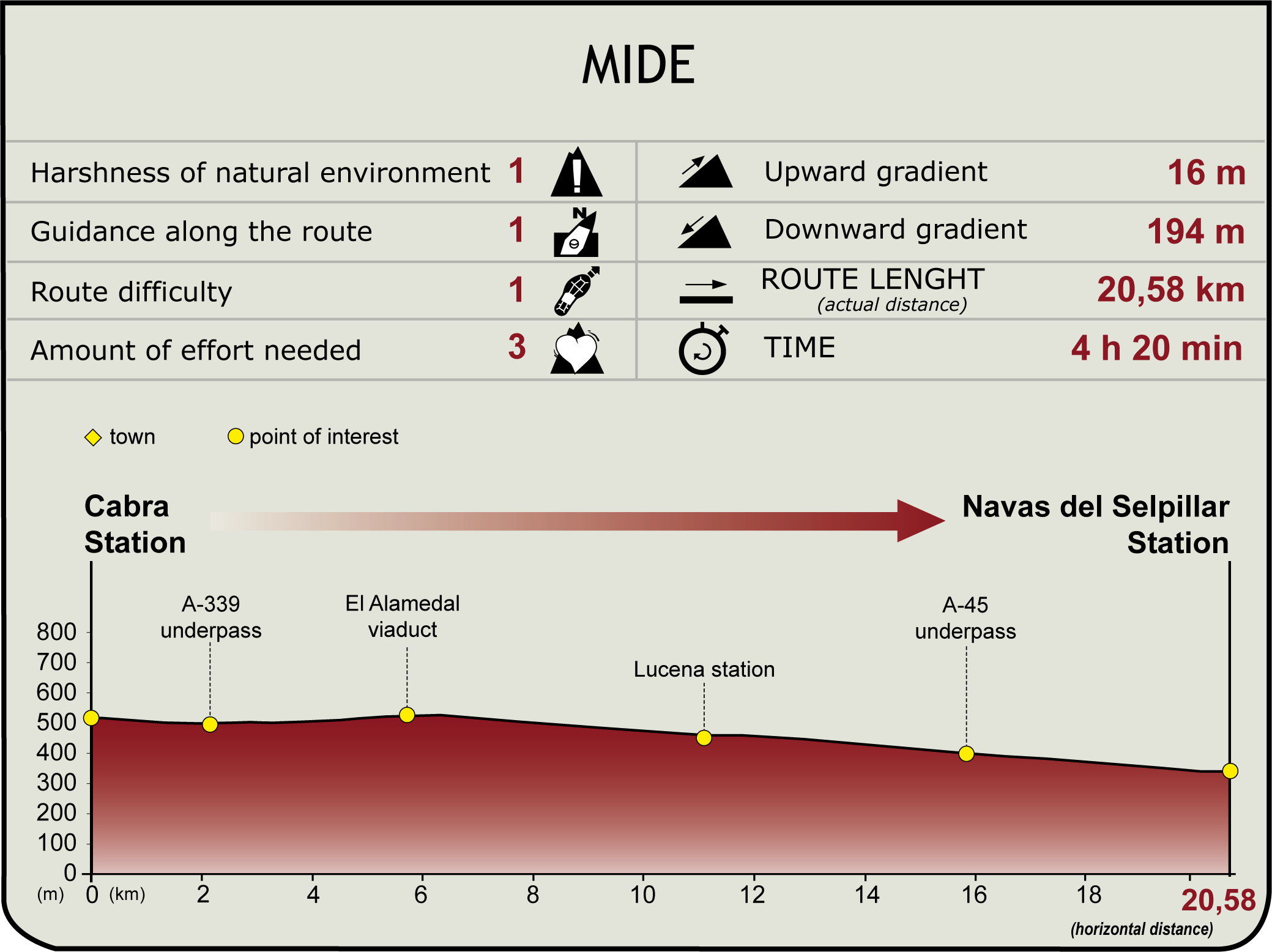
 Harshness of natural environment
- 1. The environment is not risk-free
- 2. There are more than one risk factors
- 3. There are various risk factors
- 4. There are quite a lot of risk factors
- 5. There are many risk factors
 Guidance along the route
- 1. Well defined trails and crossings
- 2. There is a clearly marked trail and signage
- 3. Requires the identification of geographic features and cardinal points
- 4. Requires off-path navigation
- 5. The trail is interrupted by obstacles that have to be gone around
 Route difficulty
- 1. Walking on a flat surface
- 2. Trails with different types of path
- 3. Walking on stepped paths or irregular terrain
- 4. The use of hands or jumping over the terrain is necessary
- 5. The use of hands is required to progress
 Amount of effort needed
- 1. Up to 1 hour of continuous walking
- 2. Between 1 and 3 hours of continuous walking
- 3. Between 3 and 6 hours of continuous walking
- 4. Between 6 and 10 hours of actual walking
- 5. More than 10 hours of continuous walking
(Calculated according to the MIDE criteria for an average excursionist with a light load)
Highlights
Further information
Lucena
With some 40,000 inhabitants, Lucena is the second most populated city in the province of Córdoba and an important economic and cultural centre. Known as the Pearl of the Three Cultures, its history reflects the coexistence of Jews, Arabs and Christians. Its name comes from the Hebrew “Eli hoshanna”, meaning “God save us”, proof of the relevance of the Jewish community that settled in this city, where the largest Jewish necropolis on the peninsula has been excavated.
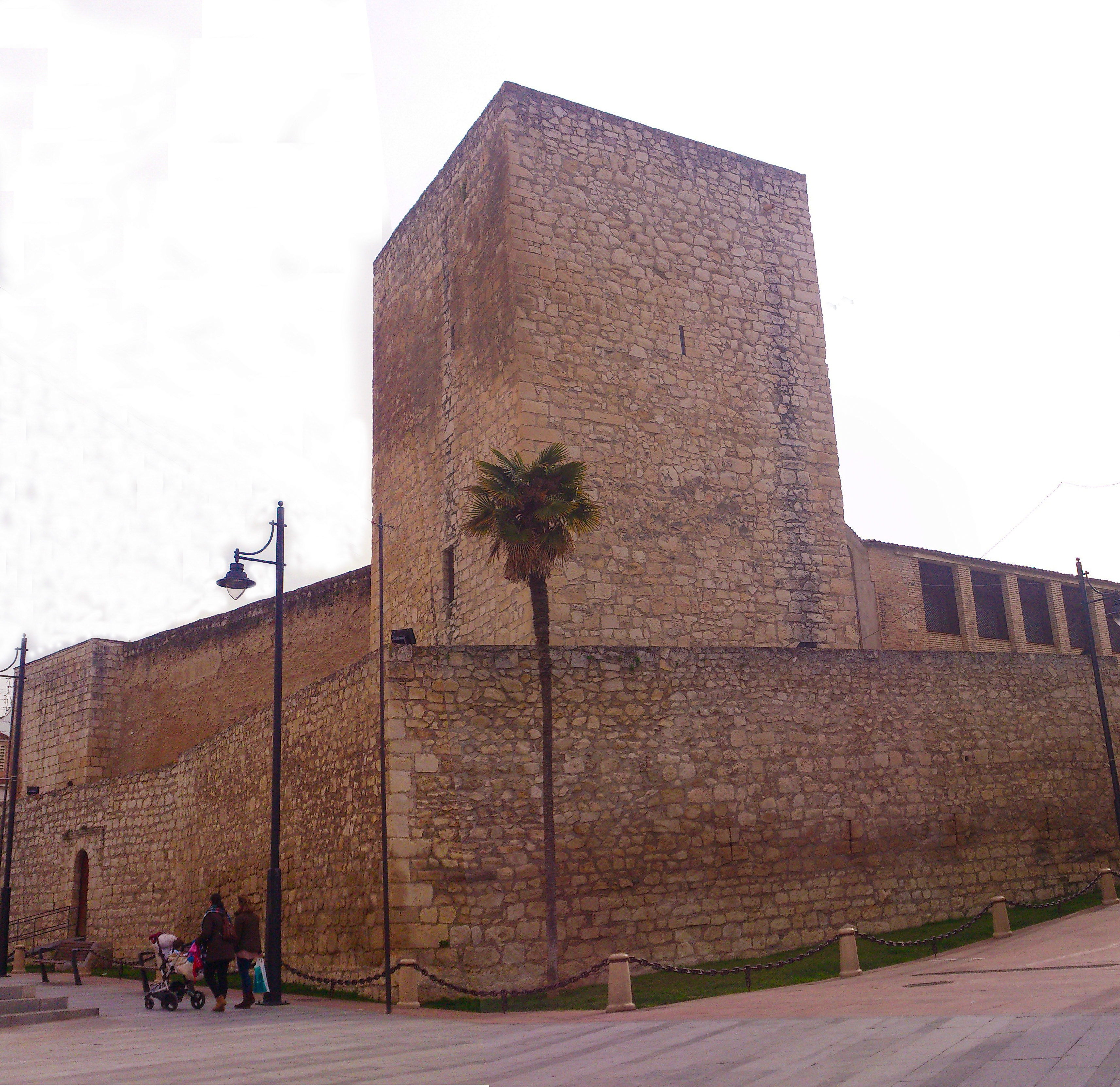
Among its most outstanding monuments are the 11th century Moral Castle, declared a National Historic Monument and famous for having been the prison of Boabdil the last Arab king of Granada, and the 16th century Church of San Mateo, a jewel of Andalusian Baroque style.
Its economy is based on the olive industry, the manufacture of furniture, and tourism, which finds in Lucena a destination full of history and tradition.
Casilla de la Cabaña del Pastor
This small house known as the Casilla de la Cañada del Pastor follows the sober and simple lines of the old railway booths. Inside the plot there are warning signs indicating that the house must have belonged to a worker and not to a gatekeeper, although there is a level crossing of a track with a road nearby. This reinforces the idea that the gatekeeper controlled only the junctions with the busiest roads. In all other cases, it was up to the walker or driver to decide when to cross, always at their own discretion and responsibility.
Multimedia




Downloads

GPS Downloads


Documents

Cyclability
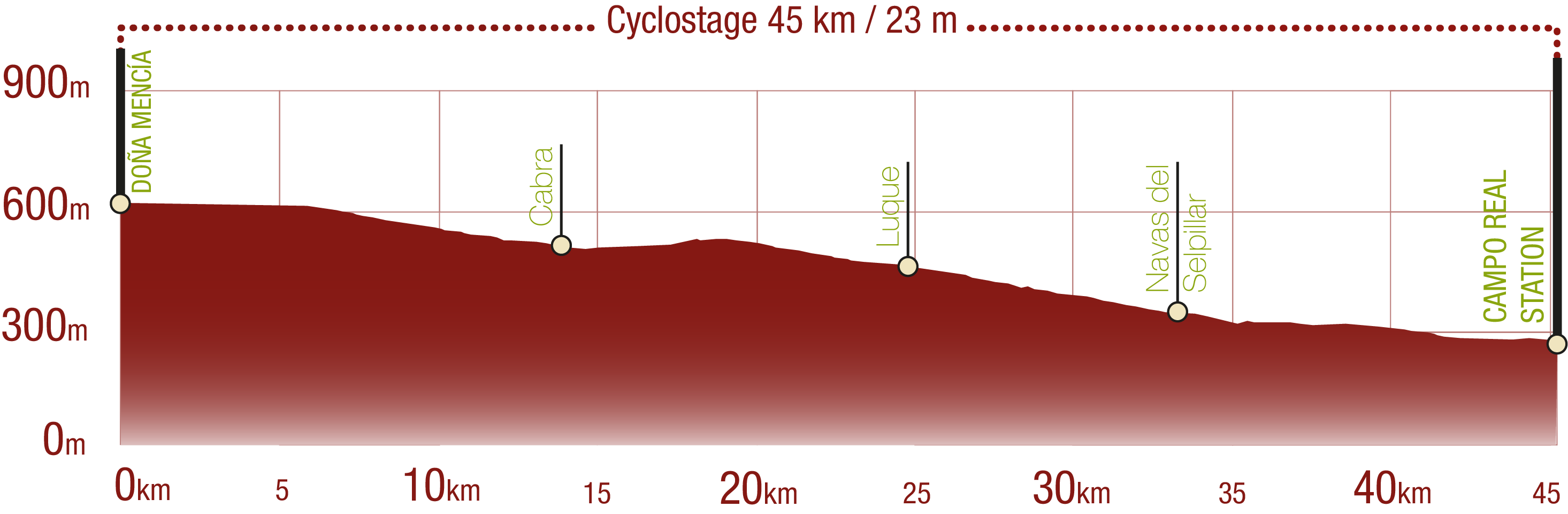
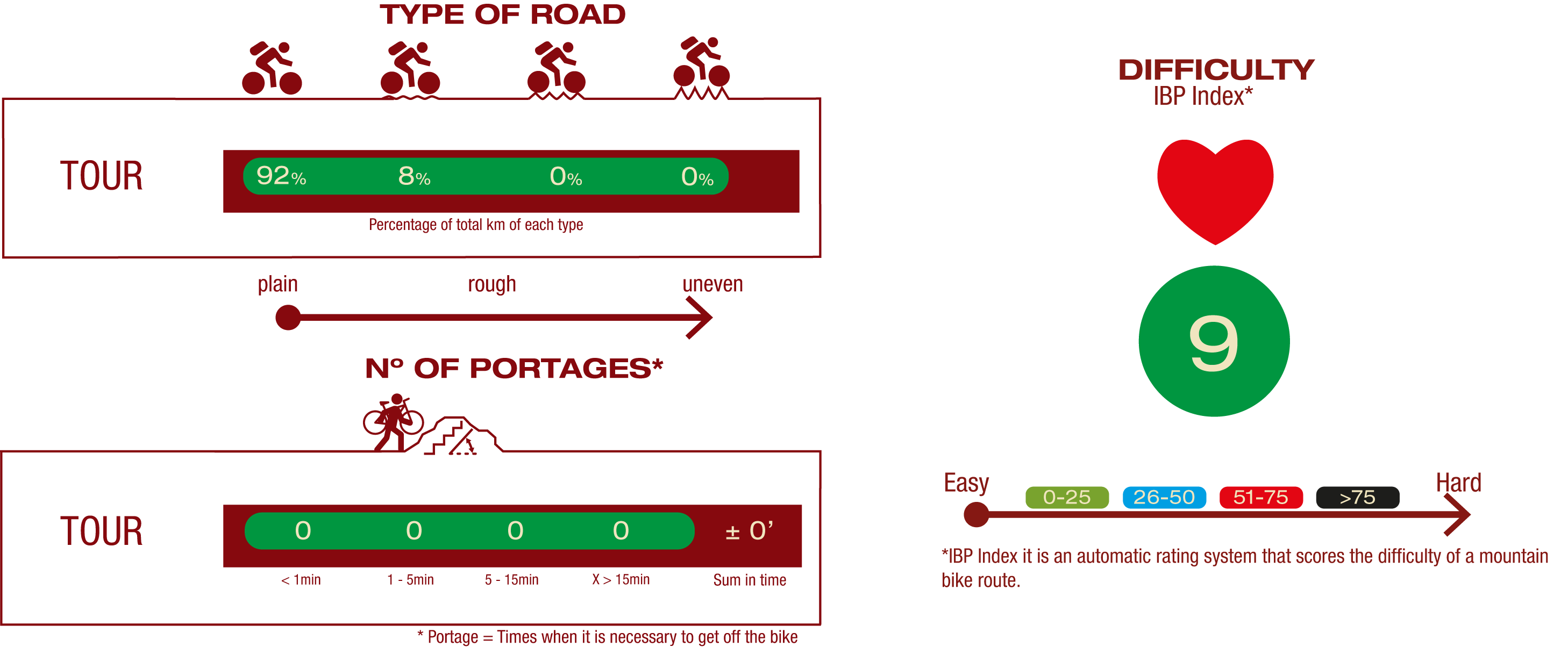
This cycling stage corresponds from Doña Mencía Station to Campo Real Station.
PROFILE
TYPE OF ROADS, PORTAGES & DIFICULTY
TEST

GENERAL RECOMMENDATIONS
- Find out about the technical aspects of the route and the weather on the day.
- Take care of the environment. Take care not to disturb animals or damage vegetation. Respect private areas.
- You must give priority to pedestrians and comply with general traffic rules.
- The environment in which you will be riding is open, free to move around and an area where many activities are carried out (sporting, forestry, livestock and agricultural activities).
- Always have an understanding, prudent, responsible and respectful attitude.