


Net of Nature
Trails

Stage 7: Doña Mencía Station – Cabra Station







Description
Cycling through the heart of Subbética.
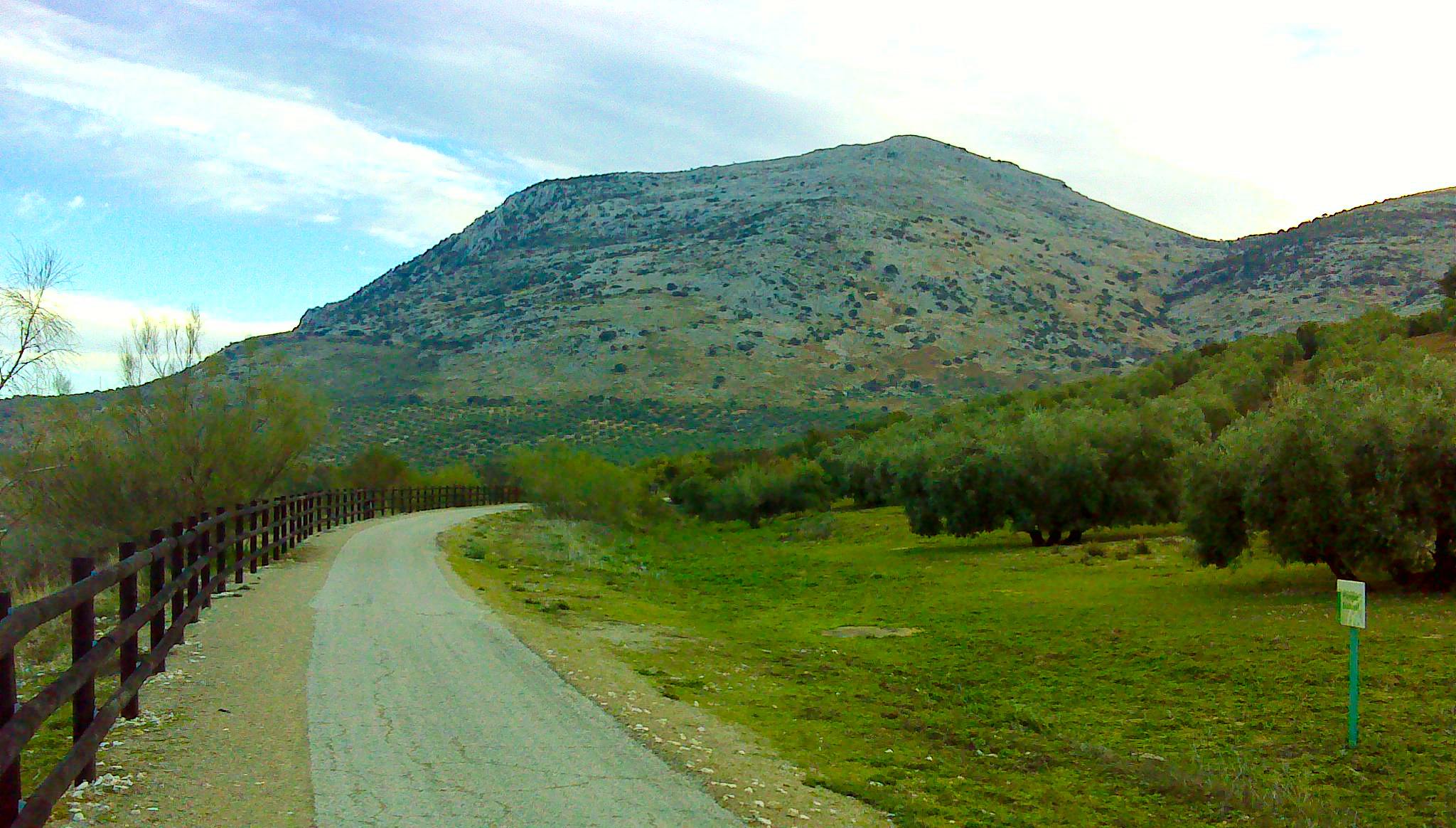
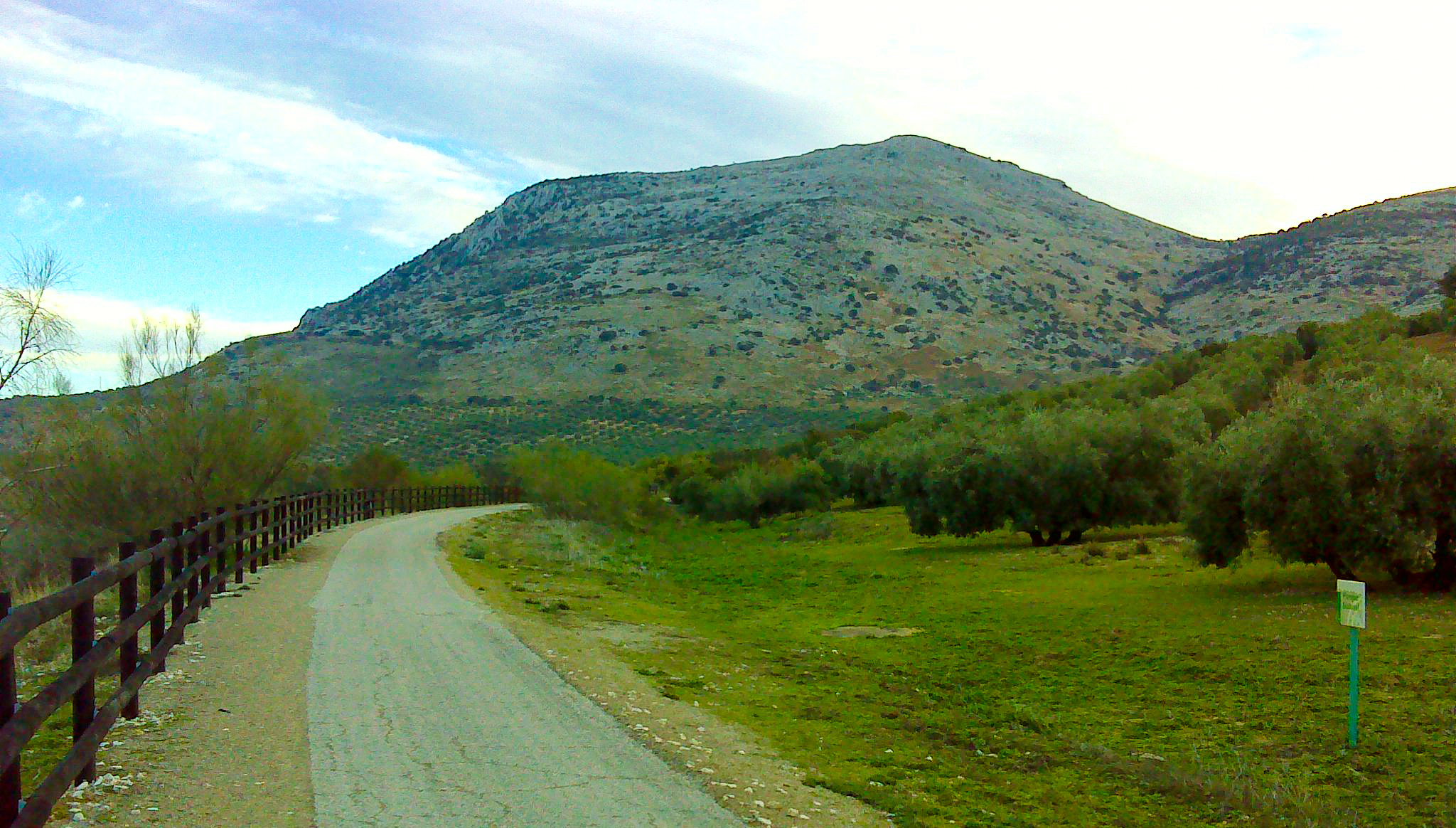
This stage of the Olive Oil Greenway Nature Trail begins at the Doña Mencía railway station and invites you to enter the heart of the Sierras Subbéticas Natural Park and World Geopark. The route allows you to enjoy the old iron infrastructures from the 19th century that formed part of the historic Olive Oil Railway, among landscapes of endless olive groves, curious geological formations and corners with valuable expanses of Mediterranean woodland.
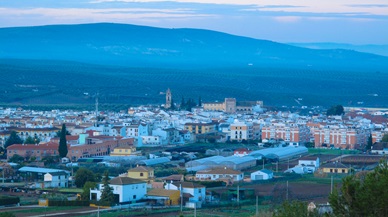
The starting point of this new 12.7 km stage of the Olive Oil Greenway Nature Trail is at the Doña Mencía station, which, like others on the old railway line, has been repurposed as a restaurant. On the right is the village known for its famous Montilla-Moriles wine cellars. In the old cargo dock of the station is the Subbética Bike Centre for Tourists, where it is possible to rent bicycles directly at the starting point of the Nature Trail. There is also a parking area for motorhomes in the old station facilities and an information point on the route, the nearby municipalities and the Sierras Subbéticas Natural Park, which can be accessed by trails that branch off the Nature Trail itself.
Barely two kilometres after the start of the stage, continuing to the west parallel to the N-432 road, there is another railway installation that has been restored as a cycle-tourist information centre and resting area. It was formerly a railway booth used to house a worker specialised in track maintenance. Following the route along the old railway track, the path crosses several infrastructures built to allow the passing of trains, such as artificial trenches where the olive trees momentarily disappear from view, viaducts over roads and streams, and the Plantío tunnel, the only one on the entire route located behind a wooded area of Mediterranean forest.
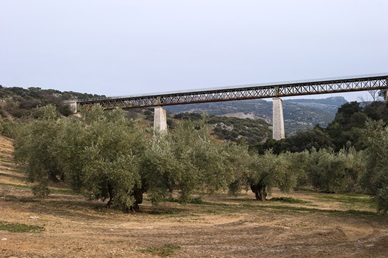
After passing the Plantío tunnel, the journey continues between gentle slopes and views of the Subbética massif, reaching the Sima Viaduct after a few kilometres, one of the most spectacular examples of 19th century railway engineering. This iron structure, designed by the French engineers Daydé and Pillé in 1890, is 132 m long and is also a popular place for adventure sports. A kilometre and a half further on is the Los Dientes de la Vieja Viaduct, which is 25 metres long and crosses the Ratas Creek and the CO-6211 road. The curious name of Los Dientes de la Vieja (Spanish for “the old woman’s teeth”) comes from the unique geological formations that surround it, reminiscent of the silhouette of sharp teeth.
Three kilometres later, between olive groves, clearings and areas of Mediterranean scrubland, and after crossing the CO-6211 road taking extreme precautions, you reach the old Cabra station, the end of the seventh stage of the Olive Oil Greenway Nature Trail. This second-class station was commissioned in 1891 and, like others on the historic “Olive Oil Railway”, it has a restaurant, a parking area for motorhomes, a children's area and an information point. The Sima de Cabra Route, one of the most emblematic trails in the area, starts very close by.
Management entities
Sites of interest
Puntos de interés
Culture
Geology
Hydrography
Information
Infrastructure
Municipality
Hostel
Vegetation
Passport
Profile
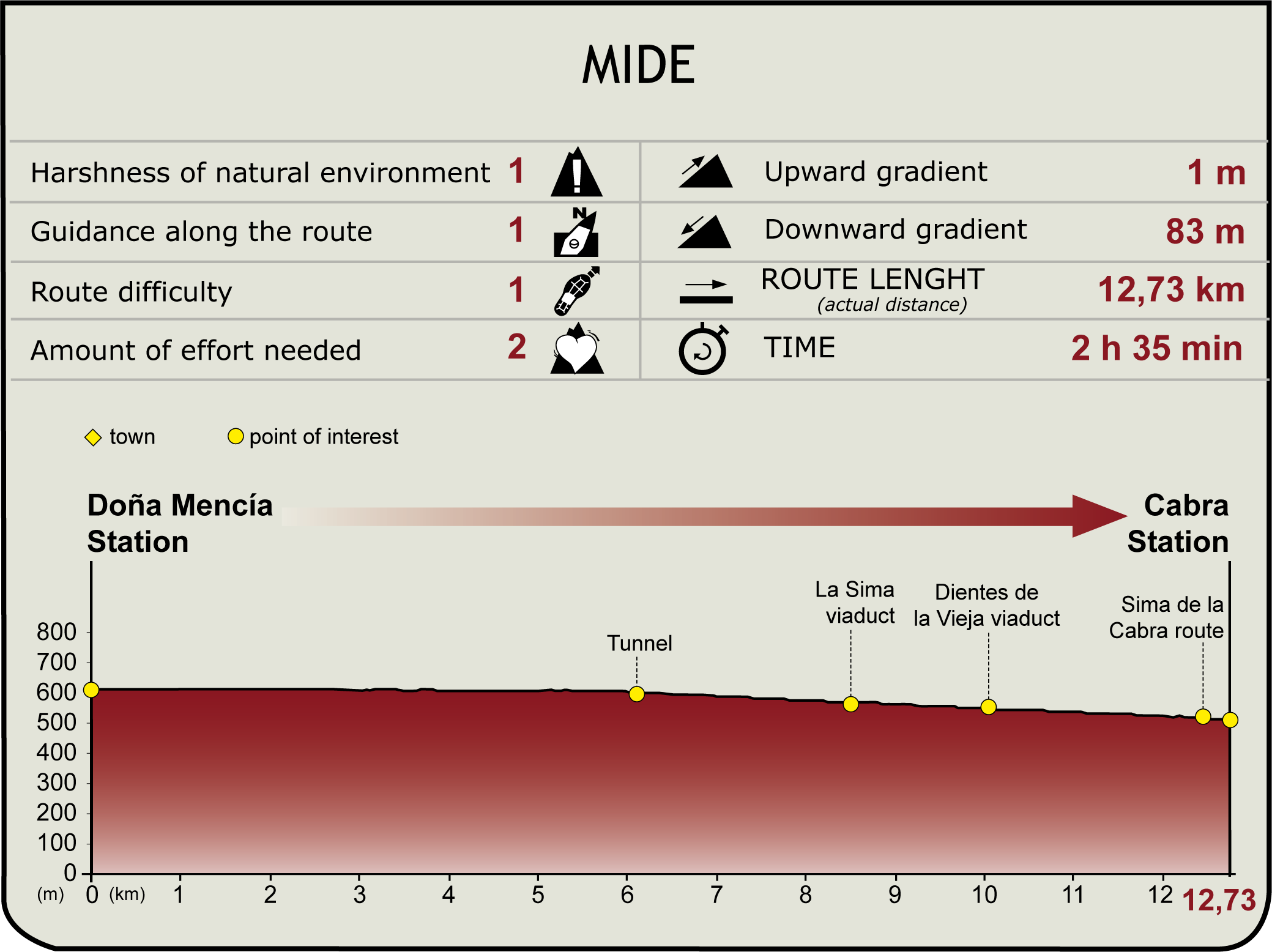
 Harshness of natural environment
- 1. The environment is not risk-free
- 2. There are more than one risk factors
- 3. There are various risk factors
- 4. There are quite a lot of risk factors
- 5. There are many risk factors
 Guidance along the route
- 1. Well defined trails and crossings
- 2. There is a clearly marked trail and signage
- 3. Requires the identification of geographic features and cardinal points
- 4. Requires off-path navigation
- 5. The trail is interrupted by obstacles that have to be gone around
 Route difficulty
- 1. Walking on a flat surface
- 2. Trails with different types of path
- 3. Walking on stepped paths or irregular terrain
- 4. The use of hands or jumping over the terrain is necessary
- 5. The use of hands is required to progress
 Amount of effort needed
- 1. Up to 1 hour of continuous walking
- 2. Between 1 and 3 hours of continuous walking
- 3. Between 3 and 6 hours of continuous walking
- 4. Between 6 and 10 hours of actual walking
- 5. More than 10 hours of continuous walking
(Calculated according to the MIDE criteria for an average excursionist with a light load)
Highlights
Further information
Doña Mencía
This small town, with a population that doesn’t reach 5000, is located between the Oreja de Mula hill and the San Cristóbal hill. Its origin is linked to the construction of the Old Church (currently , the church of Nuestra Señora de la Consolación) in the 15h century. Numerous archaeological sites abound in the surrounding area, the findings of which are exhibited in the local historical-archaeological museum.
At the end of April, Doña Mencía celebrates its festival in honour of San Pedro Mártir de Verona, patron saint of the town. On the 29th of April, the streets are decorated for the procession and the festivities continue for the following days. The pilgrimage of San Pedro, which takes place on the previous Sunday, is held in the place known as El Puerto, located next to the old railway station.
Cabra
With a history dating back to Roman times - when it was known as Igabrum -Cabra was conquered by the Christian army in 1240 and preserves an interesting monumental heritage, mostly in the Baroque style. Highlights include the Castle of the Counts of Cabra, the Parish Church of Nuestra Señora de la Asunción, the churches of Santo Domingo and San Juan de Dios, and several hermitages and convents dotted around the old town.
With a population of more than 20,000, Cabra lives mainly from olive growing, although rural tourism has become very important due to the fact that part of the municipality lies within the Sierras Subbéticas Natural Park.
Multimedia




Downloads

GPS Downloads


Documents

Cyclability
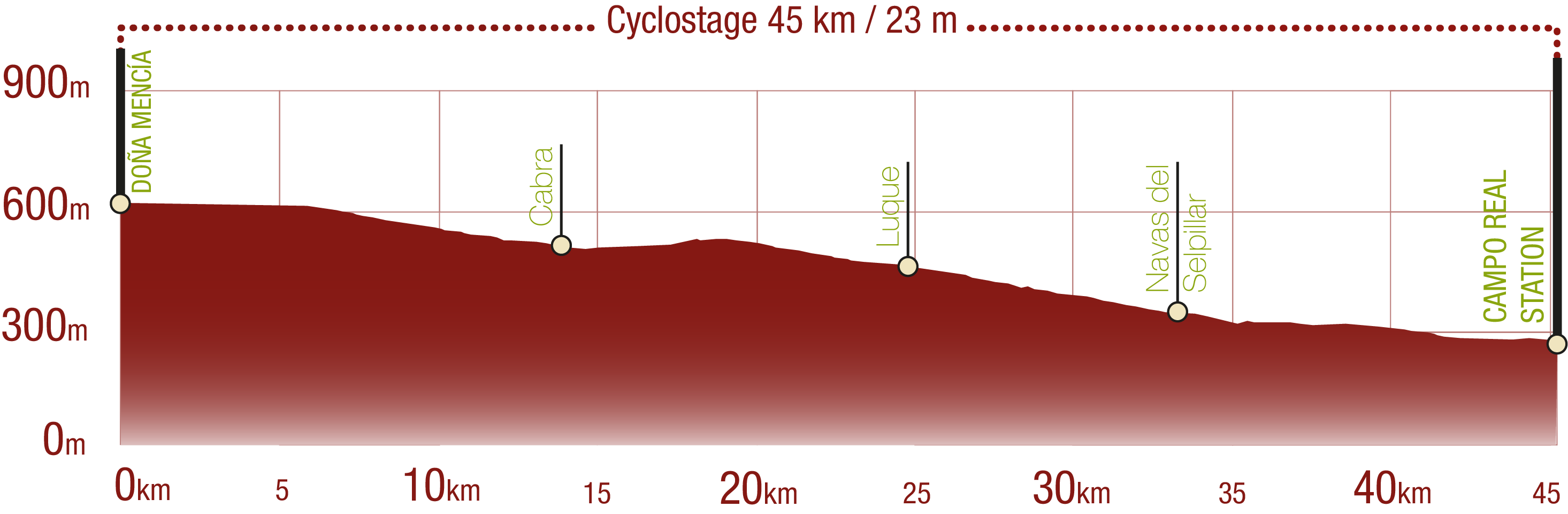
This cycling stage corresponds from Doña Mencía Station to Campo Real Station.
PROFILE
TYPE OF ROADS, PORTAGES & DIFICULTY
TEST

GENERAL RECOMMENDATIONS
- Find out about the technical aspects of the route and the weather on the day.
- Take care of the environment. Take care not to disturb animals or damage vegetation. Respect private areas.
- You must give priority to pedestrians and comply with general traffic rules.
- The environment in which you will be riding is open, free to move around and an area where many activities are carried out (sporting, forestry, livestock and agricultural activities).
- Always have an understanding, prudent, responsible and respectful attitude.