

Net of Nature
Trails

Stage 2: Torredelcampo Station – Martos Station







Description
Between olive trees and old viaducts
This second stage of the Olive Oil Greenway Nature Trail follows the old Linares-Puente Genil railway line, between the stations of Torredelcampo and Martos, in the very heart of the province of Jaén. This stage that combines the peace of a landscape dominated by olive groves with the grandeur of the 19th century engineering works, such as the viaducts designed by Eiffel's disciples and the long tunnels carved into the rock.
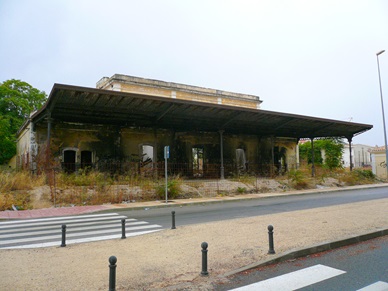
The route starts at the old Torredelcampo railway station, on the edge of the town. This infrastructure, built in the 1890s, was the seventh station on the route between Linares and Puente Genil. During its heyday it consisted on three small buildings that are still standing: one was used for the reception of travellers with a waiting room and a ticket office and the other two were used as a warehouse or water tank. In addition, the construction included living quarters for the stationmaster on the upper floor and bathrooms in the outermost buildings.
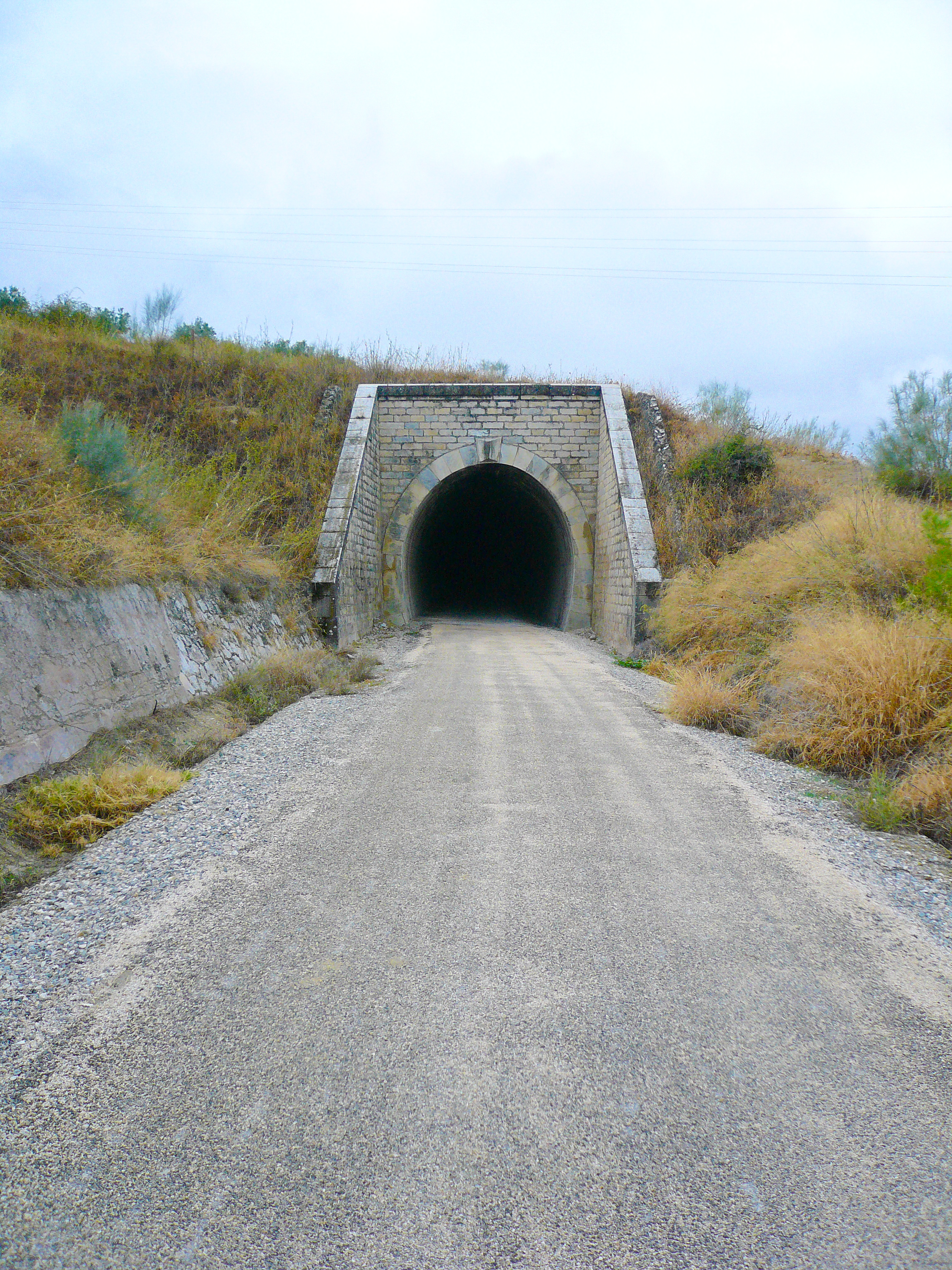
From here, the road goes straight ahead until it reaches the well-lit tunnel that crosses under the A-316 motorway. The Caballico tunnel, known as the Torredelcampo tunnel due to its proximity to the town, is 333 m long, making it the longest of the first stages of the route. Currently, it is perfectly preserved and has a lighting system that facilitates the transit of both cyclists and hikers, and it ends in a small curve.
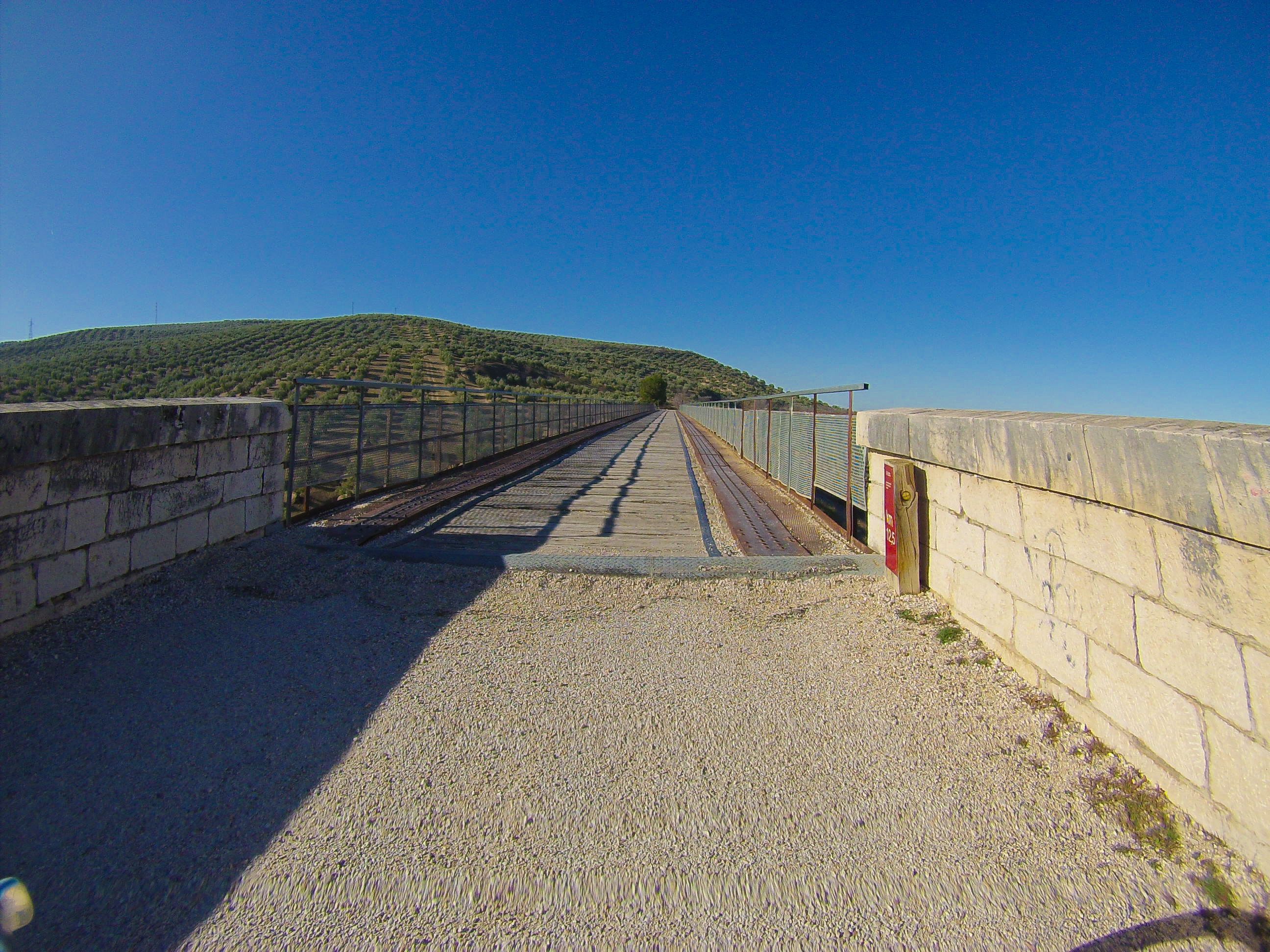
Shortly after, you can enjoy two of the gems in the route: the Piedra del Águila viaduct and the Bajo viaduct, both made of iron and built by Daydé and Pillé, disciples of Eiffel. The Piedra del Águila viaduct is a typical example of French art nouveau of the late 19th century, with a length of 104.50 m and a maximum height of 25 m. It is notable for its high quality limestone ashlar pillars and a metal railing. It is notable for its high-quality limestone ashlar pillars and its metal railing. The Bajo viaduct, designed by Alessandre and Delapierre, is almost 83 m long and 20 m high.
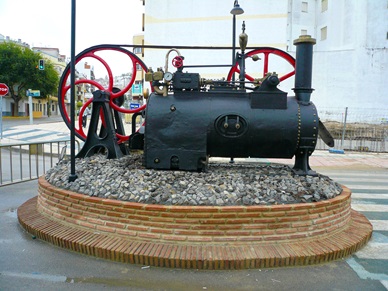
The route winds on until it reaches a new 165 m long well-lit tunnel, the Torredonjimeno tunnel. On leaving the tunnel, the Torredonjimeno town, after which the tunnel is named, appears, with its old railway halt, nowadays equipped with a rest area, perfect for a refreshing stop. This town in Jaén is well worth a visit to enjoy its extensive cultural heritage, mainly framed by its old town, declared a Site of Cultural Interest in 2005.
The path continues straight on between different crossroads of rural roads, passing over a metal footbridge that crosses the Martos road. Further on, a small stretch of the road is shared with motor vehicles and after a short descent, the A-306 road is crossed by an underpass. Shortly afterwards, road runs again along the old railway line with motor traffic segregated to make the route more pleasant to hikers and cyclists.
At this point, the path opens up into two parallel paths: follow the narrower one, on the left, which is duly signposted. The route maintains a constant course until it crosses the A-316 motorway again over a new, beautifully crafted metal footbridge, from where Martos, the final destination of the stage, can be seen.
At the entrance to the municipality, you will find three zebra crossings and after the third one, continue along the central boulevard of the Greenway avenue, protected from traffic and guarded by a row of trees. After a final zebra crossing along the aforementioned avenue, you reach the old Martos train station, the end point of this second stage of the Olive Oil Greenway Nature Trail.
From Martos also starts the La Sierra de los Ahíllos route, a circular route of almost 31 km that runs through olive groves, areas of Mediterranean scrubland and small villages or farmsteads typical of the area, which leads to the municipality of Alcaudete and returns to the Nature Trail.
Entidades gestoras
Lugares de interés
Puntos de interés
Infrastructure
- Estación de Martos
- Viaducto de Piedra del Águila
- Viaducto bajo
- Túnel del Caballico
- Túnel de Torredonjimeno
- Estación de Torredelcampo
Hostel
Profile
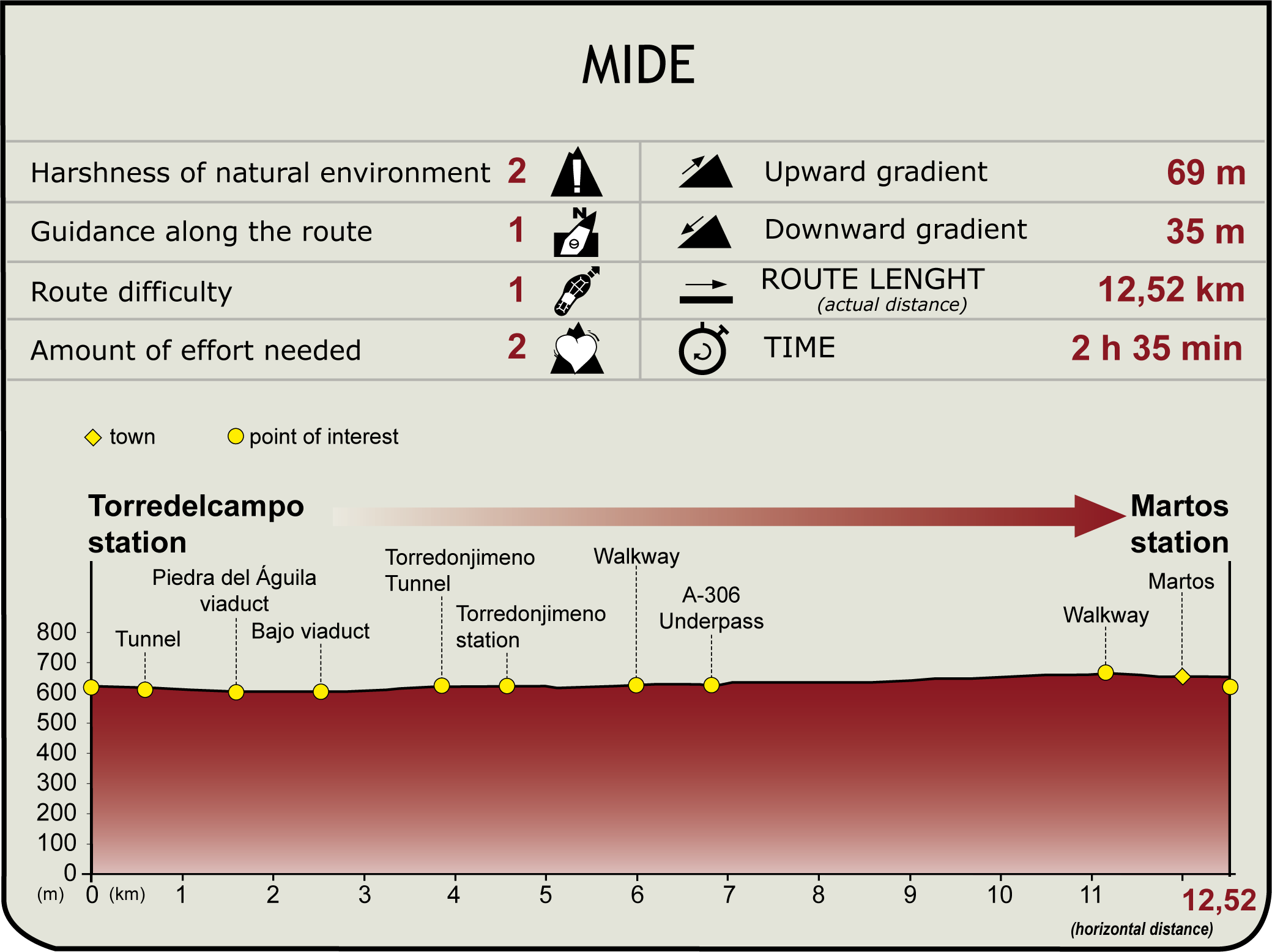
 Harshness of natural environment
- 1. The environment is not risk-free
- 2. There are more than one risk factors
- 3. There are various risk factors
- 4. There are quite a lot of risk factors
- 5. There are many risk factors
 Guidance along the route
- 1. Well defined trails and crossings
- 2. There is a clearly marked trail and signage
- 3. Requires the identification of geographic features and cardinal points
- 4. Requires off-path navigation
- 5. The trail is interrupted by obstacles that have to be gone around
 Route difficulty
- 1. Walking on a flat surface
- 2. Trails with different types of path
- 3. Walking on stepped paths or irregular terrain
- 4. The use of hands or jumping over the terrain is necessary
- 5. The use of hands is required to progress
 Amount of effort needed
- 1. Up to 1 hour of continuous walking
- 2. Between 1 and 3 hours of continuous walking
- 3. Between 3 and 6 hours of continuous walking
- 4. Between 6 and 10 hours of actual walking
- 5. More than 10 hours of continuous walking
(Calculated according to the MIDE criteria for an average excursionist with a light load)
Highlights
Further information
Proud harversters of olives
Few routes reflect the identity of Jaén as well as the Olive Oil Greenway Nature Trail does. Along the way, the horizon is covered with centuries-old olive trees, both a symbol and the economic drive of the province of Jaén. It is not in vain that olive oil gives its name to the route.
Oil production is deeply linked to the history of the Mediterranean. Olive stones have been found in prehistoric sites on the Iberian Peninsula, and olive oil from Hispania was already held in high esteem in the Roman Empire. The Arabs perfected its cultivation and extraction techniques, and today Jaén is the heart of the world's olive oil production. This "liquid gold" is an essential part of Spanish culture, both in cooking and in traditional medicine.
La Brizuela Forest
On the outskirts of Torredelcampo is the Bosque de la Bañizuela, the most emblematic natural space in the municipality. It is a small but valuable example of Mediterranean woodland with holm oaks and cork oaks, characterised by its age and its soil. A small forest that forms a green and leafy environment that contrasts with the vast olive groves of the area.
Its name comes from the old farmstead of La Bañizuela, which was originally the best garden in the area. Among its forest mass is a unique specimen of myrtle (Myrtus communis), the Arrayán de La Bañizuela (La Bañizuela Myrtle) which, due to its exceptional size, is catalogued as a singular tree of Andalusia. This green, leafy and silent corner offers a natural respite to the traveller and a good place to understand the ecological richness of the region.
Multimedia





Downloads

GPS Downloads


Documents

Cyclability
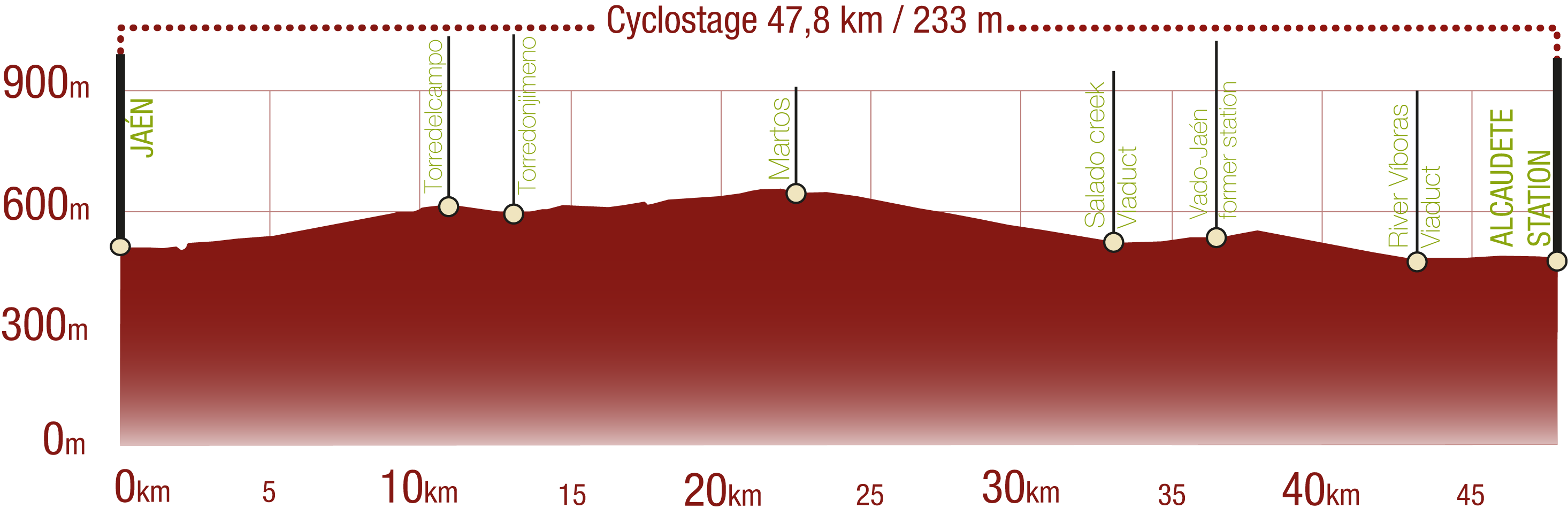
This cycling stage corresponds to the section between Jaén and Alcaudete Station
PROFILE
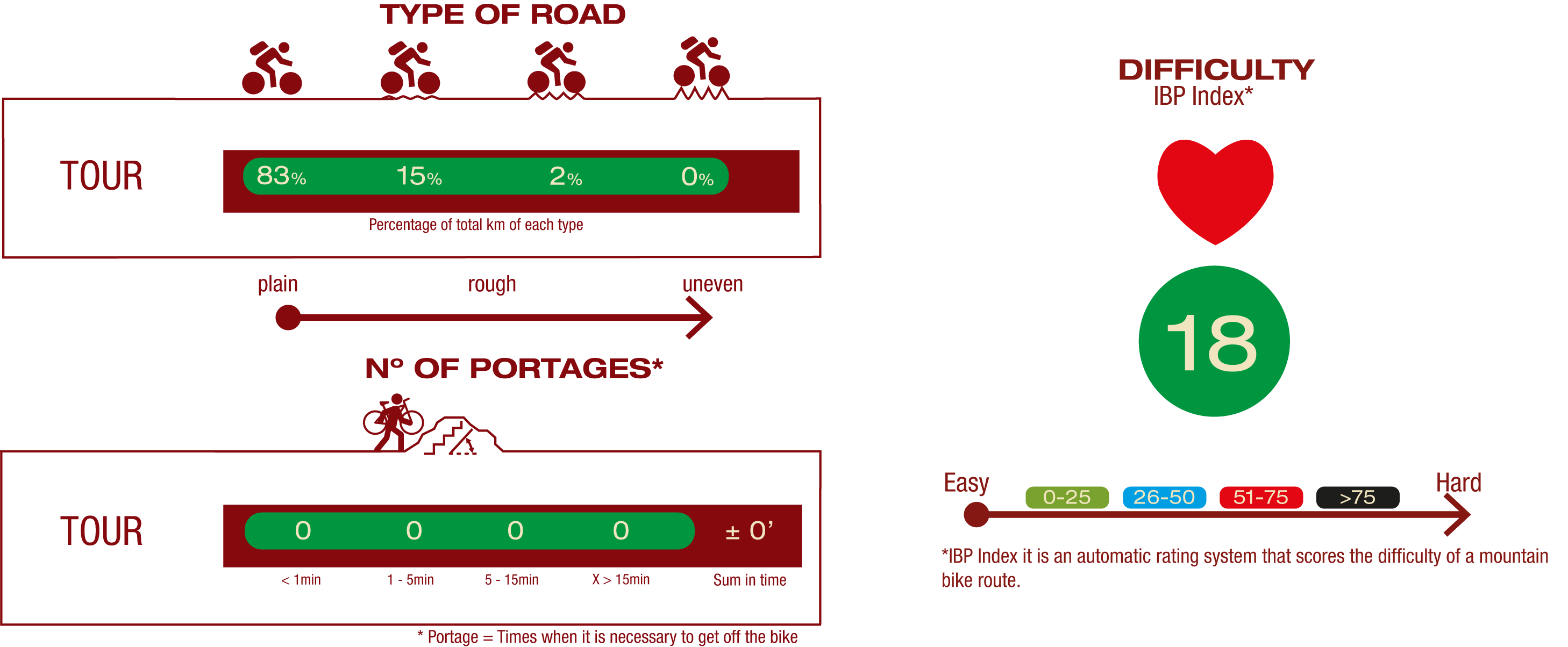
TYPE OF ROADS, PORTAGES & DIFFICULTY
TEST

GENERAL RECOMMENDATIONS
- Find out about the technical aspects of the route and the weather on the day.
- Take care of the environment. Take care not to disturb animals or damage vegetation. Respect private areas.
- You must give priority to pedestrians and comply with general traffic rules.
- The environment in which you will be riding is open, free to move around and an area where many activities are carried out (sporting, forestry, livestock and agricultural activities).
- Always have an understanding, prudent, responsible and respectful attitude.