

Net of Nature
Trails

Stage 1: Jaén – Torredelcampo Station







Description
A sea of olives
This first stage of the Olive Oil Greenway Nature Trail runs through the province of Jaén, following part of the old railway line that linked these lands with the port of Málaga. This railway line carried the flagship products of Jaén and Córdoba, especially olive oil, which is why this train was popularly known as the "Olive Oil Train".
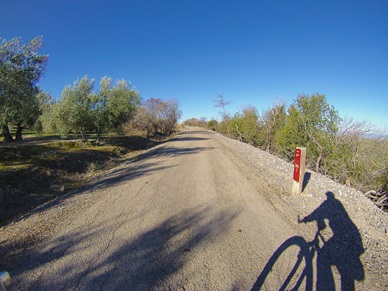
This trail starts in Jaén, by the sports centre “Fuentezuela”, which is located at Ronda Juez Juan Ruiz Rico, in the north-eastern part of the city. The starting point is connected to the urban cycle path, making it easy to access from anywhere in the city. From the very first steps, the landscape opens out into a sea of olive trees: Jaén is, in fact, the province with the highest density of olive trees in the world. This trail is not only marked by the abundance of olive trees, but so will the characteristic aroma of almazaras or olive presses.
Shortly after the start lies the access to the Archaeological Route of Los Torreones, a circular route of 32 km that returns to the Nature Trail through the Aldehuela area. This route runs through medieval fortifications, towers, castles and watchtowers that were vantage points in the wars between Christians and Muslims. If you have time, the 800 m detour to the Torre de la Aldehuela is worth the effort, where the remains of a square, two-storey fortification with ribbed vaulted roofs and an ancient hydraulic system used to irrigate the nearby fields are still preserved.
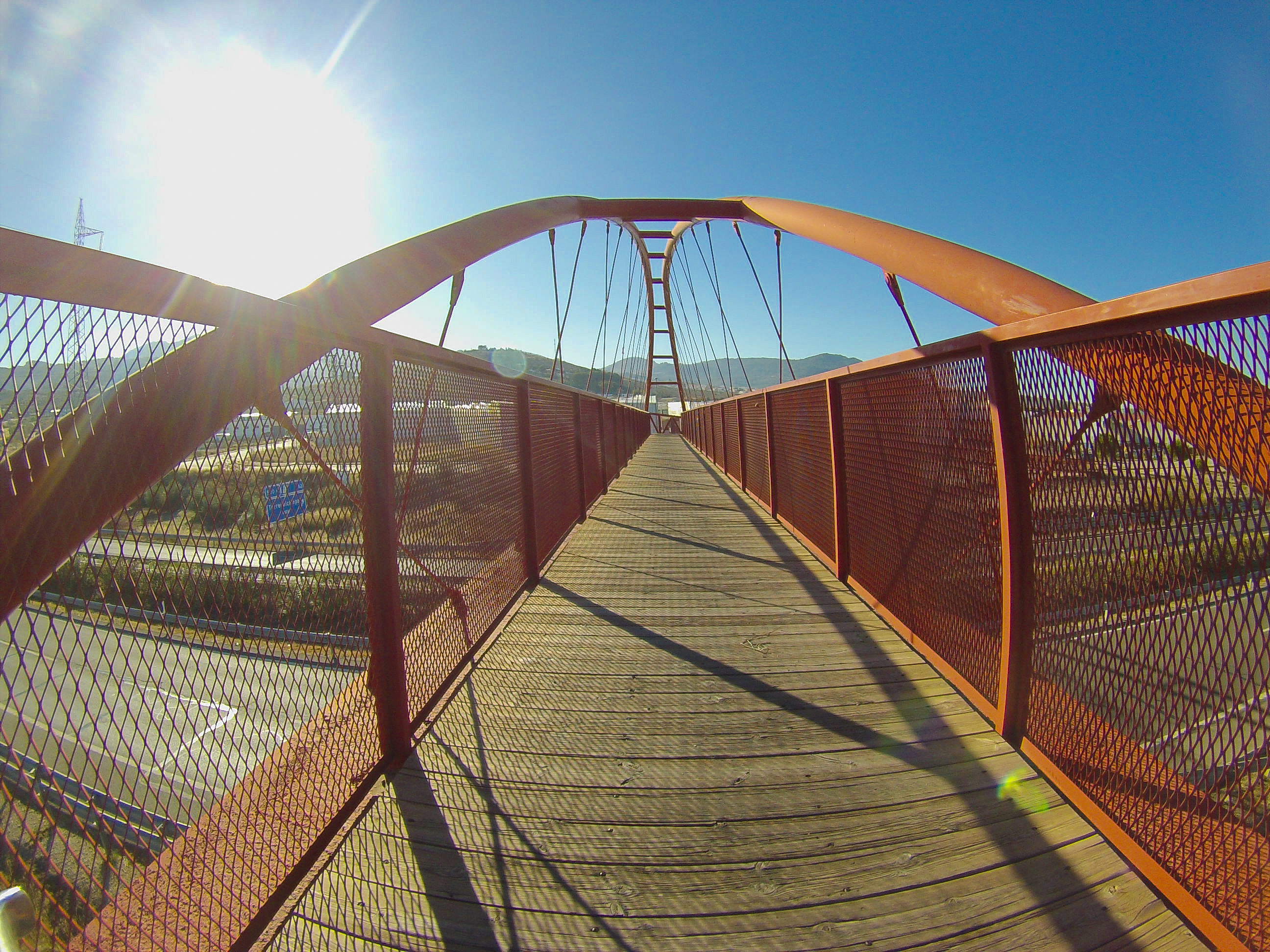
The road continues wanders on until it reaches the A-316 motorway, which the road crosses by means by an underground tunnel a few metres further on. After crossing it, a short, steep ramp is climbed and the route returns to its original direction. From here onwards, it continues along the main path, which is wider, without turning off at the forks and crossroads that appear, until it reaches the pedestrian bridge that allows you to cross the A-316 motorway again.
On the other side sits the Torredelcampo industrial estate, which you drive around until you reach a roundabout. From here the route continues to the right: just cross straight over using the zebra crossing, cross the next street also using the pedestrian crossing and continue along the pavement until returning to the route.
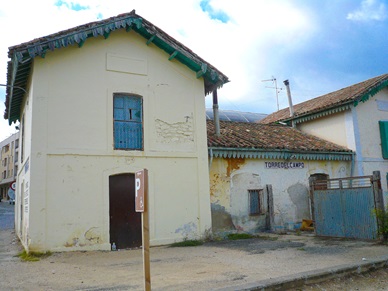
The last section runs through a leafy area until it reaches the end point of this first stage of the Olive Oil Greenway Nature Trail at the old station of Torredelcampo, an infrastructure built in the 1990s, being the seventh station on the route between Linares and Puente Genil. During its heyday it consisted on three small buildings that are still standing: one was used for the reception of travellers with a waiting room and a ticket office and the other two were used as a warehouse or water tank. In addition, the construction included living quarters for the stationmaster on the upper floor and bathrooms in the outermost buildings.
Management entities
Sites of interest
Profile
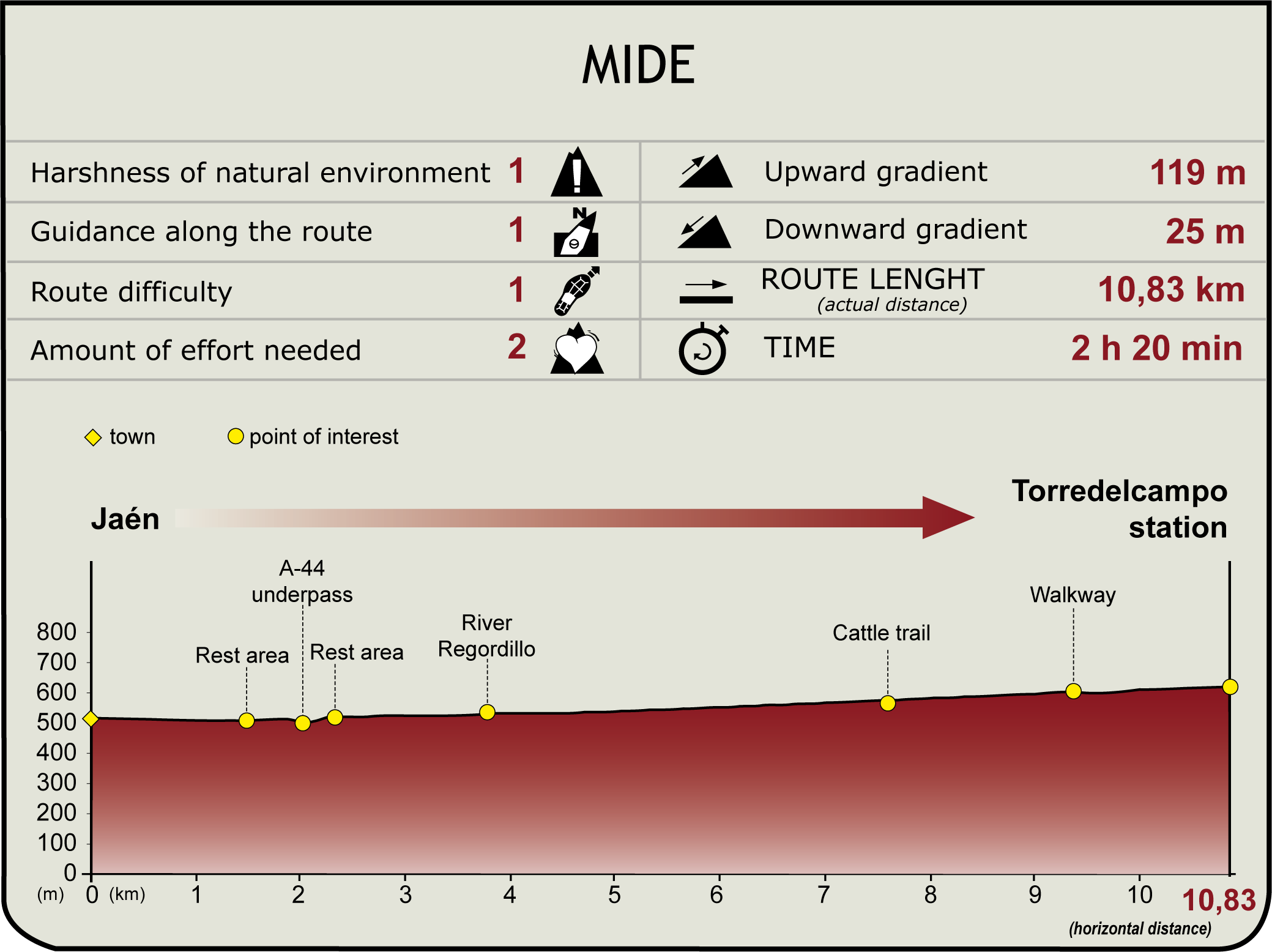
 Harshness of natural environment
- 1. The environment is not risk-free
- 2. There are more than one risk factors
- 3. There are various risk factors
- 4. There are quite a lot of risk factors
- 5. There are many risk factors
 Guidance along the route
- 1. Well defined trails and crossings
- 2. There is a clearly marked trail and signage
- 3. Requires the identification of geographic features and cardinal points
- 4. Requires off-path navigation
- 5. The trail is interrupted by obstacles that have to be gone around
 Route difficulty
- 1. Walking on a flat surface
- 2. Trails with different types of path
- 3. Walking on stepped paths or irregular terrain
- 4. The use of hands or jumping over the terrain is necessary
- 5. The use of hands is required to progress
 Amount of effort needed
- 1. Up to 1 hour of continuous walking
- 2. Between 1 and 3 hours of continuous walking
- 3. Between 3 and 6 hours of continuous walking
- 4. Between 6 and 10 hours of actual walking
- 5. More than 10 hours of continuous walking
(Calculated according to the MIDE criteria for an average excursionist with a light load)
Highlights
Further information
On the Battlefield
The province of Jaén has been shaped by history, as is it an area in which Carthaginians, Romans, Muslims and Christians have settled. Due to its location - as a gateway to Andalusia via the Guadalquivir River and a natural passage to Castile through the Sierra Morena - it has been the scene of countless clashes between peoples and kingdoms. Some of these battles marked the course of Spanish history, such as the Battle of Navas de Tolosa in 1212, which marked the beginning of the end of Muslim rule on the Iberian Peninsula, or the Battle of Bailén in 1808, the first defeat of the Grande Armée in Europe.
This heritage is reflected in the Route of the Castles and Battles, a cultural itinerary organized around the fortifications, castles and monuments of Jaén, Granada and Ciudad Real, many of which are close to the route of this Nature Trail.
Jaén
Known as “the world capital of olive oil", Jaén is a city with a rich historical and cultural heritage surrounded by a sea of olive trees that have shaped its identity and its economy.
A stroll through its narrow streets is an invitation to discover its essence through its gastronomy: traditional dishes such as ajoarriero (mashed potatoes with garlic, shredded salted cod and abundant olive oil) or pipirrana (mashed tomato, garlic, green pepper and olive oil salad, sometimes served with tuna) are the best evidence of a culture deeply linked to olive oil.
Its monumental heritage includes the imposing Cathedral of Jaén, one of the most important examples of Renaissance architectural in the country, the work of the architect Andrés de Vandelvira. In addition, the castle of Santa Catalina dominates the town from the top of a hill and offers breathtaking panoramic views of the valley and the immense mosaic of olive trees that surrounds it.
Multimedia


Downloads

GPS Downloads


Documents

Cyclability
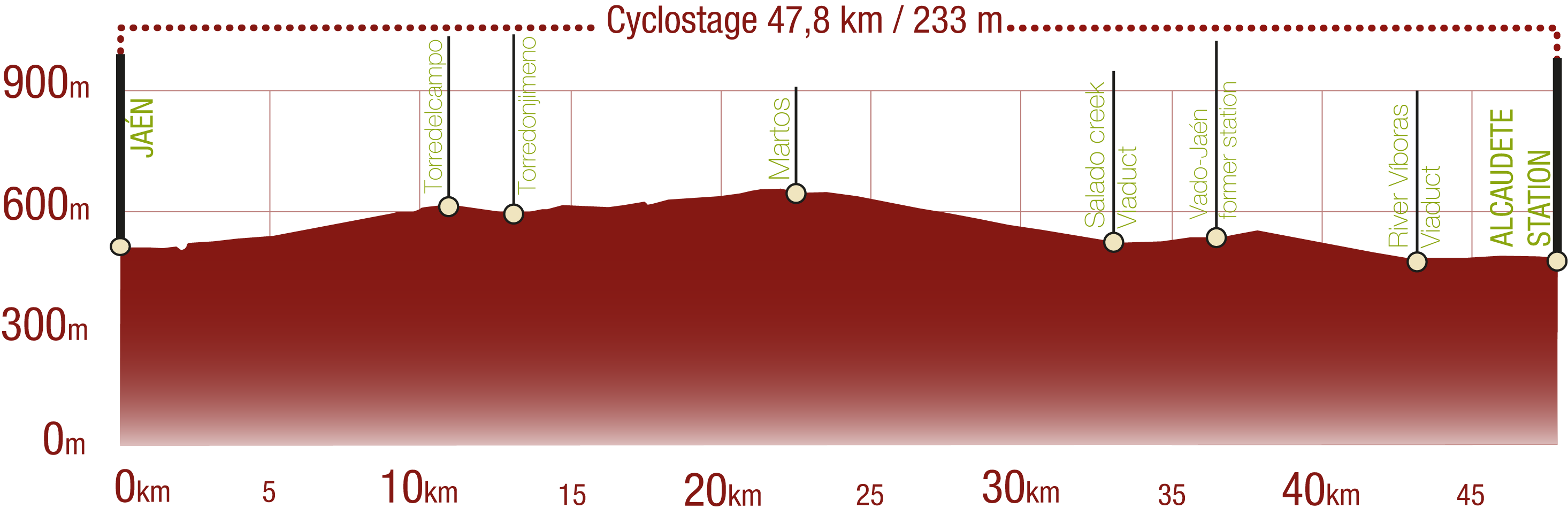
This cycling stage corresponds to the section between Jaén and Alcaudete Station
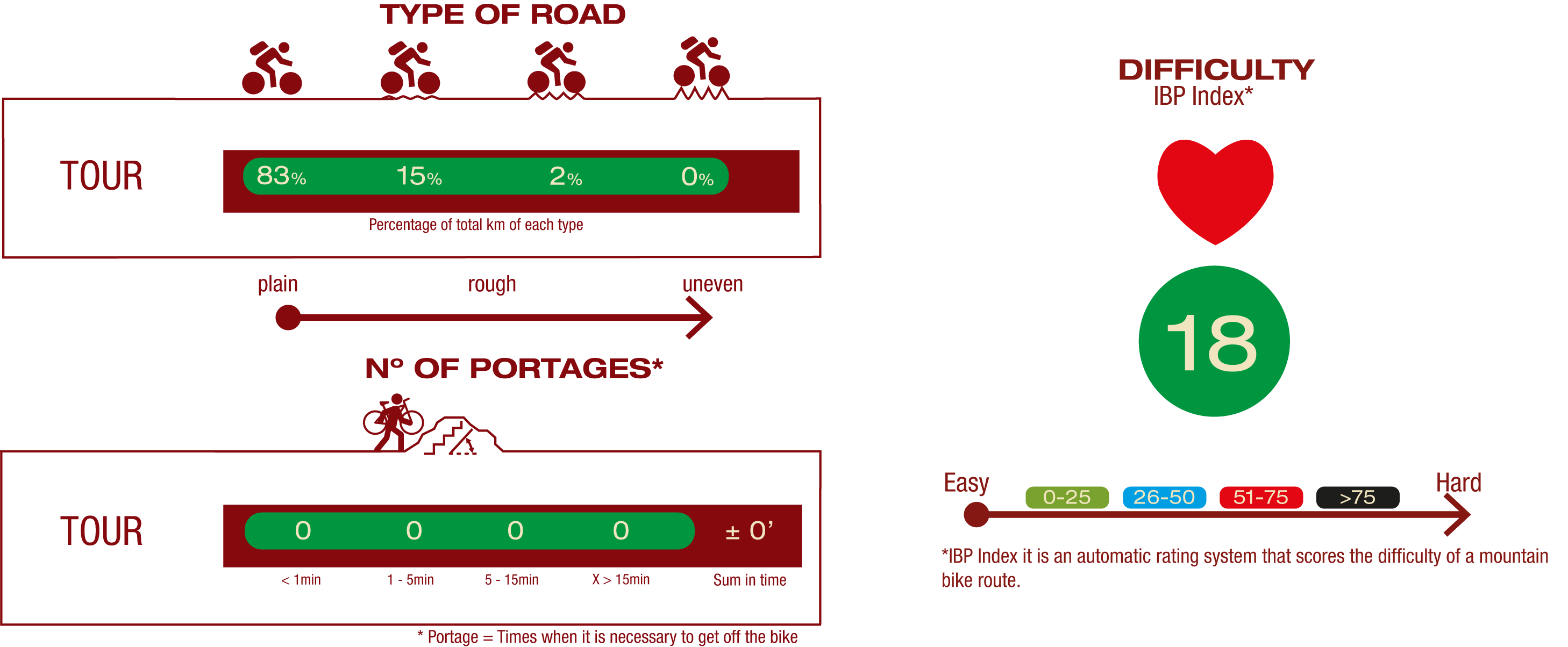
TYPE OF ROADS, PORTAGES & DIFFICULTY
TEST

GENERAL RECOMMENDATIONS
- Find out about the technical aspects of the route and the weather on the day.
- Take care of the environment. Take care not to disturb animals or damage vegetation. Respect private areas.
- You must give priority to pedestrians and comply with general traffic rules.
- The environment in which you will be riding is open, free to move around and an area where many activities are carried out (sporting, forestry, livestock and agricultural activities).
- Always have an understanding, prudent, responsible and respectful attitude.