

Net of Nature
Trails

Stage: Leitza Station - Lekunberri Station


Description
Unique tunnels surrounded by a permanently green environment
As in other parts of Spain, old railway lines have been restored for public use, allowing people to explore extremely beautiful natural landscapes. At this stage, the route also offers the chance to pass through some of the most notable tunnels in Spain’s Network of Nature Trails, including the Uitzi tunnel in Navarre, which, at 2,700 metres, is the longest in Europe – much to the delight of walkers and cycle tourists.
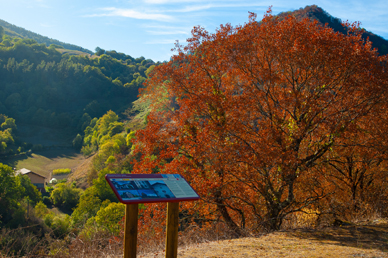
The stage begins next to the information panel located opposite the old Leitza station, a building which, together with the old warehouse, has been fully restored and is in a very good state of repair. There is also a car park, a rest area, a fountain and even a helipad here, which makes it easier to plan your route. Before setting off on the tour, it’s well worth a visit to Leitza, a town also known for having been the setting for several films, thanks to the beauty of its streets and its grand houses.
Shortly after setting off along the old railway line, the trail arrives at the Iruñaga tunnel, which is 116 metres long and has no artificial lighting. The route then passes the Tellería tunnel – which has now collapsed – on the right.
There are four tunnels in the next 3 km. The first is the Kantina, which is 170 metres long and fitted with lighting. Shortly afterwards, the Urbieta tunnel appears; it is 152 metres long and is also fitted with lighting. Next comes the Leitza Tunnel, which is 649 metres long – the second longest on the route – and is lit by artificial lighting. Finally, the route passes through the Malkorra tunnel, which is 102 metres long and has no artificial lighting.
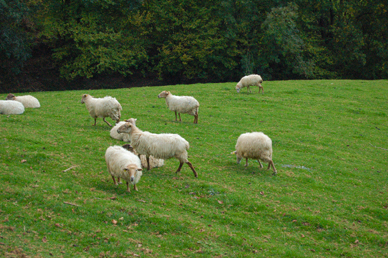
Between one tunnel and the next, the route winds its way through woods and meadows where Latxa sheep graze; their milk is used to make the famous Idiazábal cheese with Protected Designation of Origin (PDO). Along this stretch, beautiful panoramic views of the Leitzaran Valley can be enjoyed, leaving the village of Leitza behind for good.
The trail meets six other tunnels over the next few kilometres: Tunnel 2, Autxikeneko, Erasote, Tutenea, Tunnel 1 and Guitarraren Buelta. The landscape combines meadows and small larch (Larix decidua) forests, which give way to native species such as the beech (Fagus sylvatica), which forms beautiful, shady canopies.
A few metres after emerging from the Guitarraren Buelta tunnel, the route curves to the left and heads south. This is when the trail reaches reach the most iconic spot on the Plazaola Greenway Nature Trail: the entrance to the Uitzi tunnel, which, at 2,700 metres in length, is the longest tunnel in Spain’s Network of Nature Trails and the longest in the whole of Europe that is suitable for walkers and cycle tourists, with no motor traffic.
The tunnel crosses the watershed between two major river basins: to the south, the Ebro basin, via the Larraun River, and to the north, the Cantabrian basin, via the Leitzaran River. The abundant water seepage inside the tunnel has, over time, led to the formation of calcium carbonate deposits, which lend the central section of the tunnel a great deal of beauty. This infrastructure is well lit and the road surface is in excellent condition. However, due to its length, the use of a torch is recommended; this recommendation also applies to the other tunnels along the Plazaola Greenway Nature Trail.
Soon after the exit of the Uitzi tunnel, the trail turns right and runs along the NA-1700 for 300 m. In this section of the road, the old Uitizi station is found, which now has been turned into a private house and farm. The route then continues along the old railway line, on a gentle, comfortable descent, running parallel to the NA-1700 until the path passes through the next tunnel.
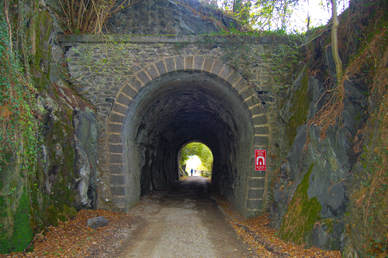
Before reaching the entrance to the Bartolo Tunnel, a turn-off allows the most adventurous cycle tourists to access Hirumuga Park, a mountain bike (MTB) circuit run by Lekunberri Town Council and Lekunberri Bike. The route combines climbs, descents, jumps and bends through the dense, shady forest, which offers an unbeatable setting for practising this daring sport.
Back on the route, the Bartolo Tunnel is closed due to the risk of rockfalls; the trail, therefore, turns right onto a well-surfaced and clearly signposted track which, after skirting the tunnel, rejoins the old railway line, where it is once again sheltered by the canopy of the mixed woodland, where find oaks (Quercus robur), sweet chestnuts (Castanea sativa), beech trees (Fagus sylvatica) and hazel trees (Corylus avellana), amongst other species, can be found.
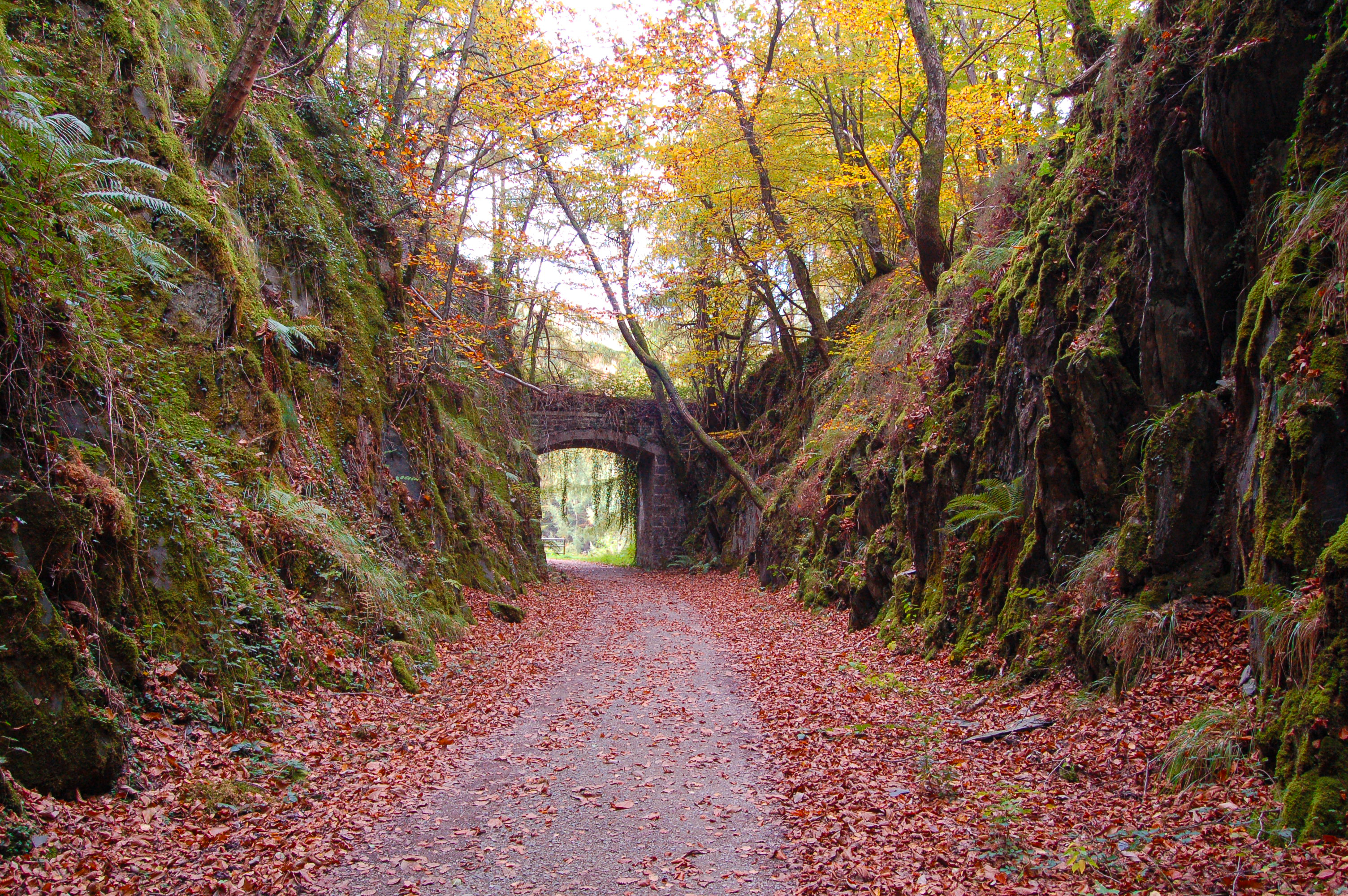
After a downhill stretch, the route runs parallel to the A-15 motorway, whilst the town of Lekunberri lies on the other side of the road. After reaching a crossroads and passing through a stretch of deep, beautiful cuttings, the road turns right to pass under the A-15 motorway through a modern tunnel. Next, it turns left and goes through another tunnel, which forms part of the old railway line and has no artificial lighting.
The final stretch runs alongside the houses in Lekunberri until it reaches the old railway station, where the Nature Trail information panel marks the end of the stage.
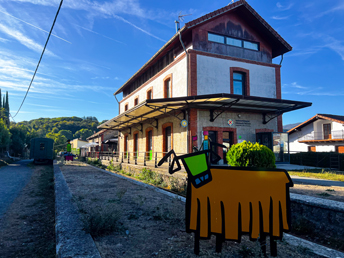
The old Lekunberri station is the main hub of the Plazaola Greenway Nature Trail. This is where the Plazaola Tourism Consortium has its headquarters and its Tourist Information Point, as well as being the stamping point for the Nature Trails and Greenways Passport. It includes information about other places of interest in the area and allows one to discover local produce.
Next to the station, the old railway warehouse building has been refurbished and now operates as a bar and restaurant. In the same area, there is an interpretation centre housed in an old railway carriage, as well as a car park and public toilets, to start or end your journey in comfort.
Managing entities
Links of interest
Puntos de interés
Information
Infrastructure
- Túnel 1
- Túnel Guitarran Buelta
- Túnel de Bartolo
- Túnel
- Túnel Erasote
- Estación de Uitzi
- Túnel Tutenea
- Túnel PK 16,5
- Túnel Aurtxikeneko
- Túnel Iruñaga
- Túnel Kantina
- Túnel Leitza
- Túnel 2
- Túnel Malkorra
- Túnel Uitzi
- Estación de Lekunberri
Municipality
Profile
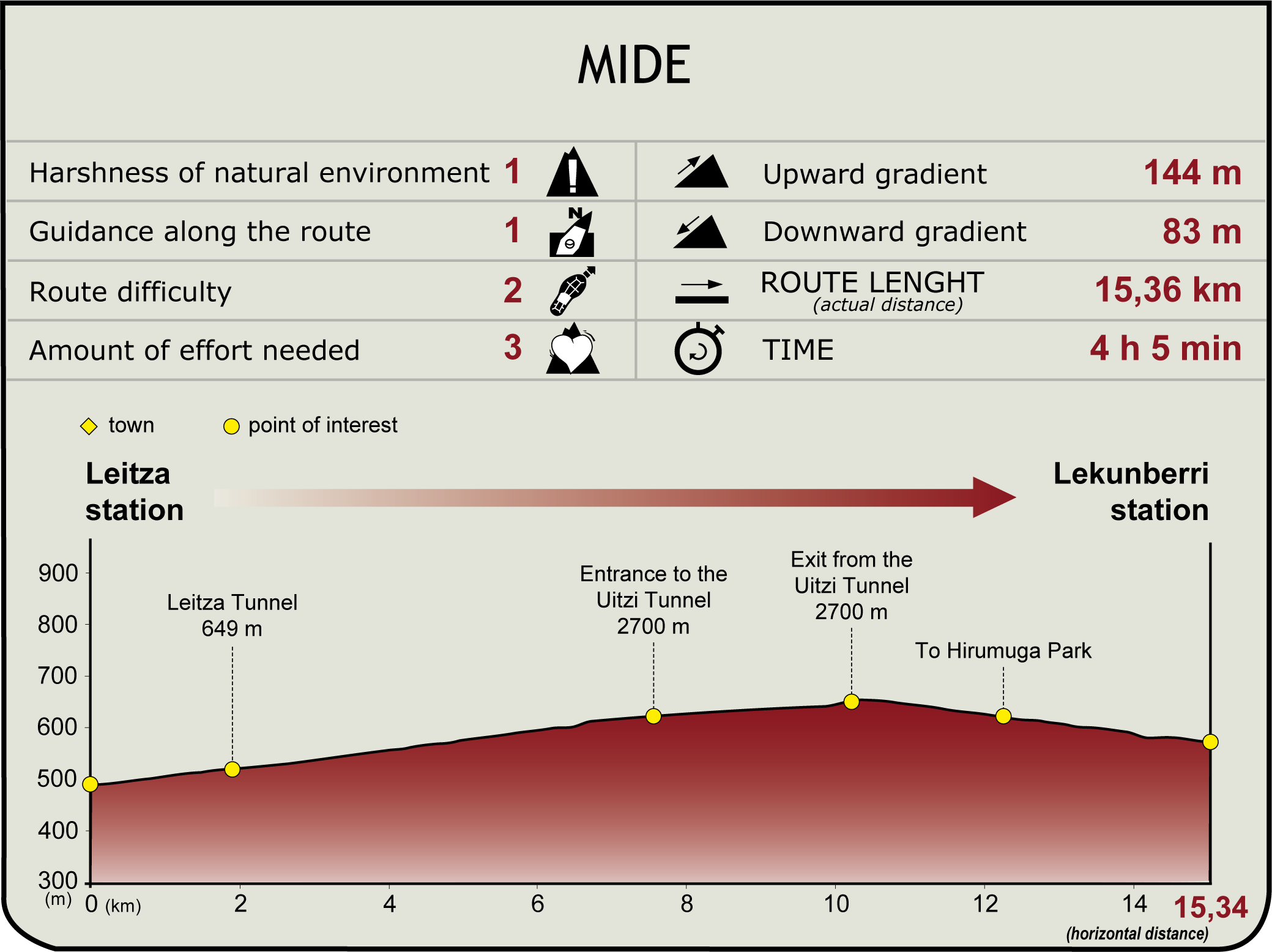
 Harshness of natural environment
- 1. The environment is not risk-free
- 2. There are more than one risk factors
- 3. There are various risk factors
- 4. There are quite a lot of risk factors
- 5. There are many risk factors
 Guidance along the route
- 1. Well defined trails and crossings
- 2. There is a clearly marked trail and signage
- 3. Requires the identification of geographic features and cardinal points
- 4. Requires off-path navigation
- 5. The trail is interrupted by obstacles that have to be gone around
 Route difficulty
- 1. Walking on a flat surface
- 2. Trails with different types of path
- 3. Walking on stepped paths or irregular terrain
- 4. The use of hands or jumping over the terrain is necessary
- 5. The use of hands is required to progress
 Amount of effort needed
- 1. Up to 1 hour of continuous walking
- 2. Between 1 and 3 hours of continuous walking
- 3. Between 3 and 6 hours of continuous walking
- 4. Between 6 and 10 hours of actual walking
- 5. More than 10 hours of continuous walking
(Calculated according to the MIDE criteria for an average excursionist with a light load)
Highlights
Latxa sheep
The Latxa sheep is a popular breed in the Basque Country, Navarre and the rest of the Cantabrian coast, and is possibly the most ancient of the Spanish sheep breeds. The word ‘latxa’, of Basque origin, means ‘coarse’ and refers to the long, rugged wool produced by sheep of this breed.
The history of this breed is closely linked to the mountainous regions of Navarre, where it has traditionally formed part of the livelihood of many families involved in livestock farming.
This breed of sheep is notable for its hardiness, agility and ability to adapt to rugged terrain and areas with high rainfall. Because their wool does not soak in water, sheep are quickly dried off after the rain. Another distinctive feature is that Latxa rams are always ready for a fight.
Milk production is one of the main uses of this breed and is used, amongst other things, to make cheeses covered by the Idiazábal and Roncal designations of origin. The lambs are weaned very early and are traditionally reared for meat as 30-day suckling lambs, or lechazos, with a live weight of between 10 and 12 kg. The meat from these lambs is in high demand and highly prized.
Wool, characterised by its ‘coarse’ texture, was traditionally used in the manufacture of mattresses, hence the name ‘mattress wool’. It is currently exported and used in the manufacture of carpets and rugs
Multimedia


Downloads

GPS Downloads


Documents

Cyclability
PROFILE
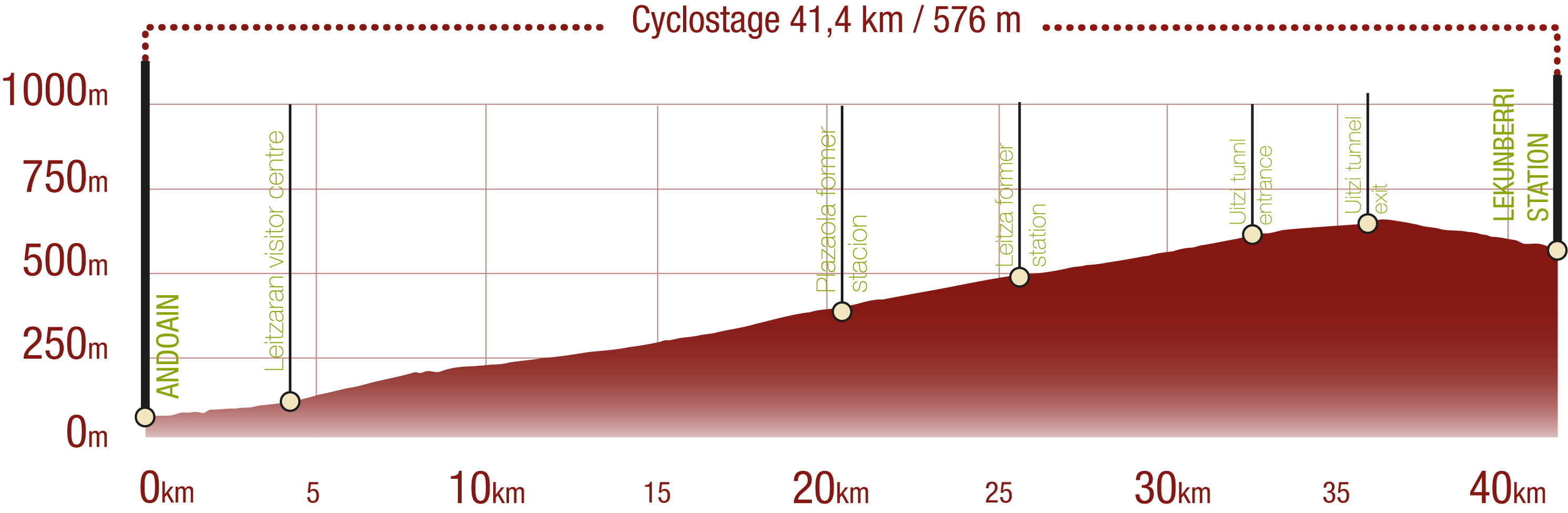
TYPE OF ROADS, PORTAGES & DIFFICULTY
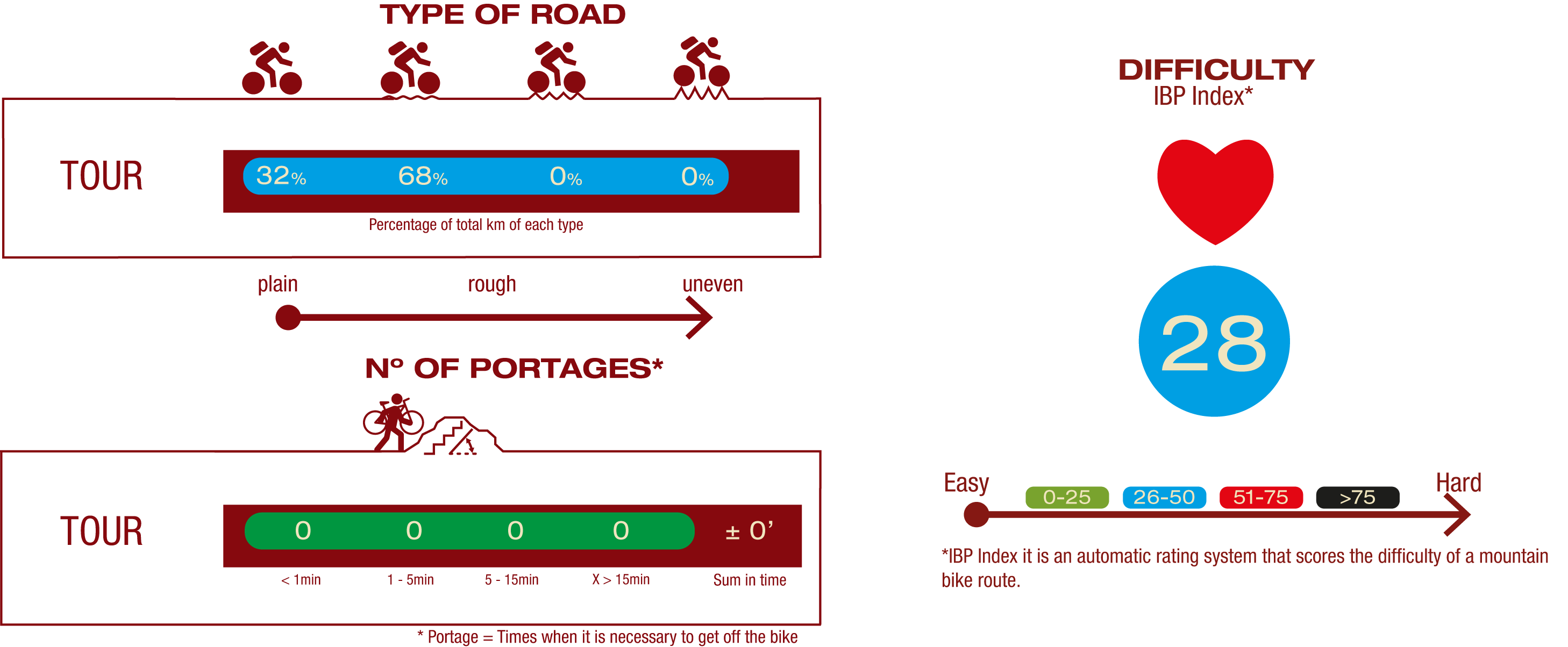
TEST

SAFETY RECOMMENDATIONS
The route features 46 tunnels along the cycle route, 39 of which have no lighting. Of the seven tunnels with artificial lighting, the Leitza Tunnel is 649 metres long and the Uitzi Tunnel is 2,700 metres long. For all these reasons, it is essential to have a bike light to ride through them. Furthermore, some of them may have puddles inside. There are several sections shared with motor vehicles, where the necessary precautions must be taken; furthermore, the route passes through the town centre of Andoain, where extreme care must also be taken. The route passes over 15 viaducts with a good road surface and kerbing on both sides.
GENERAL RECOMMENDATIONS
- Find out about the technical aspects of the route and the weather on the day.
- Take care of the environment. Take care not to disturb animals or damage vegetation. Respect private areas.
- You must give priority to pedestrians and comply with general traffic rules.
- The environment in which you will be riding is open, free to move around and an area where many activities are carried out (sporting, forestry, livestock and agricultural activities).
- Always have an understanding, prudent, responsible and respectful attitude.