
Puntos de Interés

Vegetation
Kermes oak (Quercus coccifera)
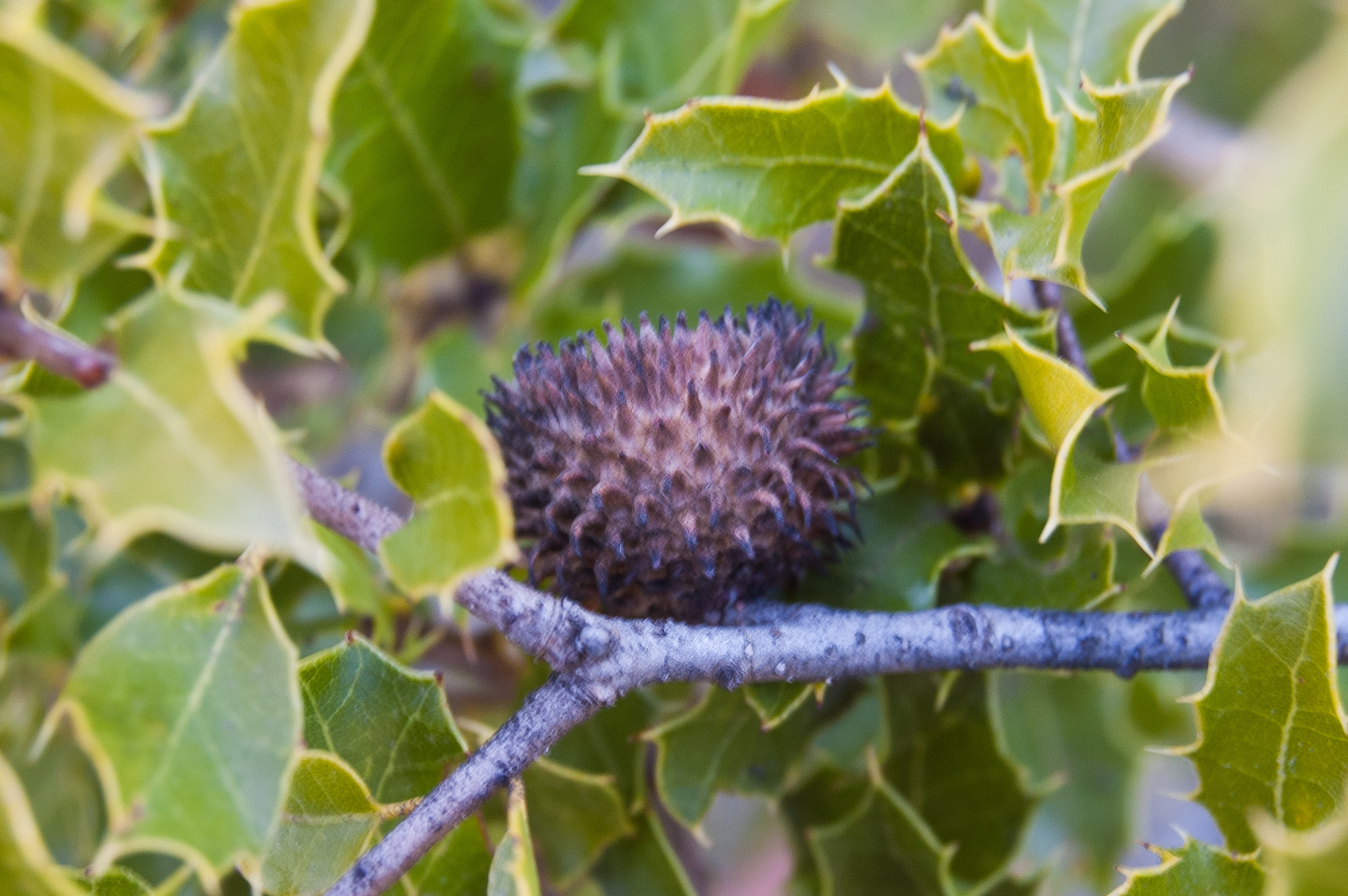
The Kermes oak is an oak shrub usually around two metres in height and rarely reaching a tree-like structure. This species has a smooth, ashen bark that tends to crack with age. Its leaves can be oblong and elliptic, with a toothed-spiny edges. They are dark green on the upper side and yellowish-green on the underside and rarely feature indumentum, although there are some hairs on the underside which are quickly lost. The fruit is shaped like a chestnut-coloured acorn when ripe and its dome features oval-lanceolate scales, the lower ones being applied and the middle and upper ones often have prolongations in the form of a rigid, sharp point.
The kermes oak grows on dry, stony soils and tolerates extreme weather with prolonged droughts quite well, although it can be quite sensitive to frost. It is an essential species from an ecological point of view, as it provides an exceptional refuge for fauna and also serves to protect the soil. It can be found at altitudes ranging from 1,000 to 1,200 m and usually shares forests with species such as holm oak, common juniper, wild olive, Mediterranean dwarf palm and carob. Although it is a species with an important distribution in the east of the Iberian Peninsula, there are no particularly significant masses of Kermes oak in this part of Teruel.
Regarding the uses of this species, it has traditionally been highly valued for tanning hides. In ancient times its black dye was used as a hair dye and its bitter fruits have astringent properties. Its wood can also be used to make very good quality charcoal, although it is not one of the most widely used for this purpose, due to its small size.