

Puntos de Interés

Geology
Rambla de Valdemiedes site
In geological terms, the village of Murero is home to an enormously important palaeontological site. This is the Rambla de Valdemiedes, which contains one of the most complete Cambrian stratigraphic series in the world, which gives us an idea of what the seabed which covered this territory was like five hundred and twenty million years ago.
This enclave was discovered in 1862 by the French geologist De Verneuil, who found various species of trilobites from the Cambrian, a period of great interest due to the great diversification that took place among the few forms of life that had existed until then, and the appearance of the modern ecosystems familiar to us today.
The Government of Aragon declared it an Asset of Cultural Interest for being one of the most important sites in the world when it comes to understanding the evolution of life on our planet, since it is exceptionally rich in palaeontology, including soft-bodied organisms and skeletal organisms.
Known as the “Sistine Chapel of trilobites”, the richness of this site is mainly due to the great variety of fossils found there, its biostratigraphic importance, with a depth of as much as 200 m, as well as a curious peculiarity: there has been an almost continuous record at the bottom of a marine platform for 10 million years, which is completely unheard of anywhere else in the world. Thus, around 80 species of trilobites - 20 of which are unique in the world - and 30 different genera have been described, all of which have an excellent conservation status. Many species of trilobites were originally recorded in Murero and some were later found elsewhere.
There are doubtless compelling reasons why the Rambla de Valdemiedes has become a site of pilgrimage for scientists and scholars from the five continents who visit the site to conduct studies and write papers of various kinds. However, it is estimated that only 40% of the biodiversity housed in its rock strata is known.
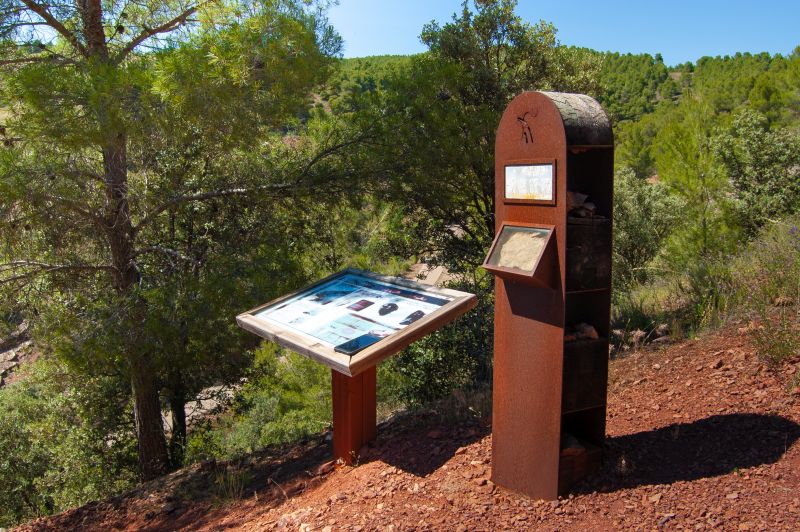
The site offers visitors three different interpretative itineraries whereby they can discover the history and geological past of this area using comprehensive information stands where they will find some of the geological and natural curiosities in this area, such as the Jiloca thrust fault, the stratification and the lithology of the area or some of the most significant tree species.