


Puntos de Interés

Culture
Church of San Vicente
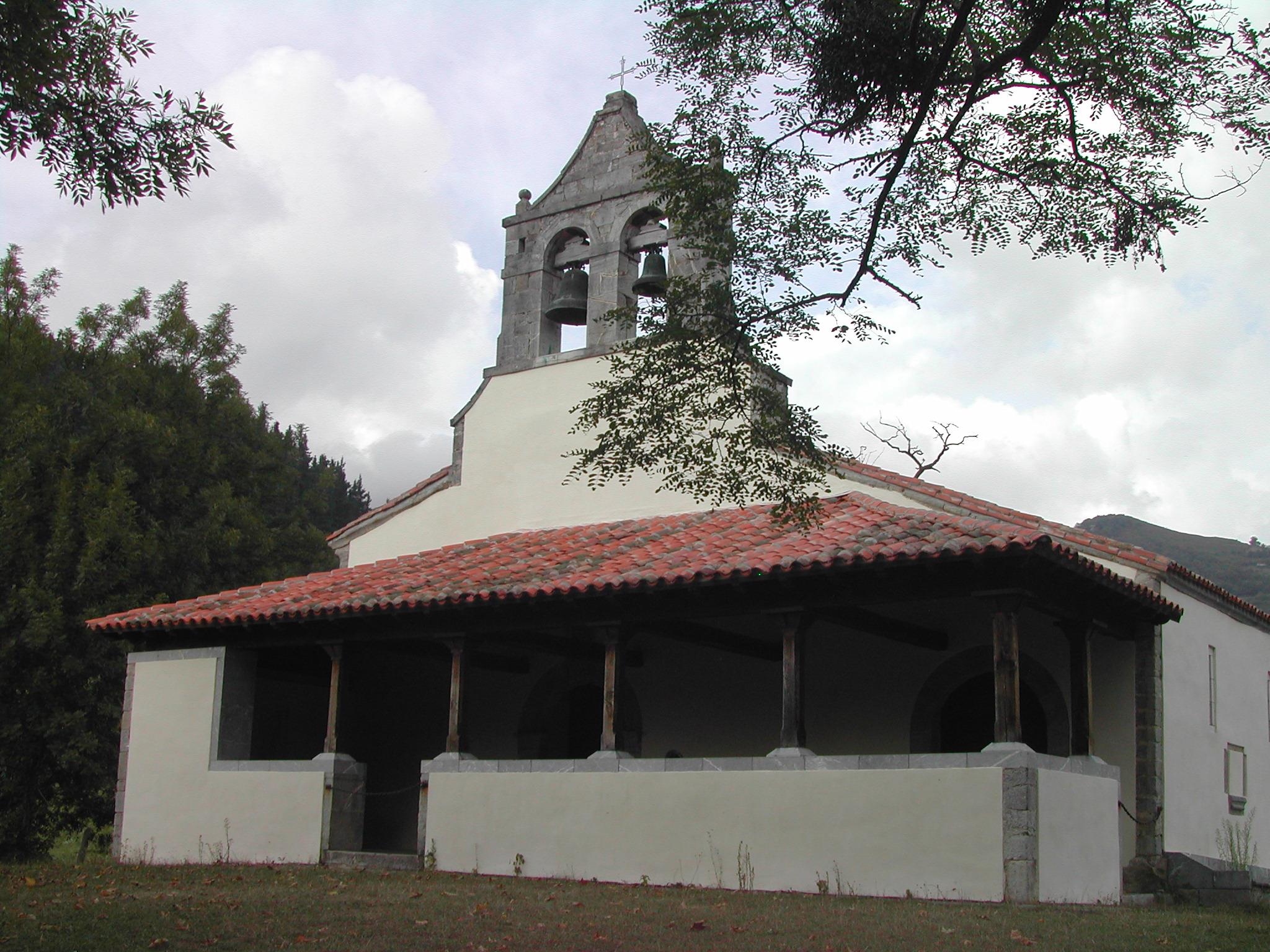
The church of Saint Vincent stands near Serrapio on the hilltop overlooking the river Aller valley. Declared a Historic-Artistic Monument in 1983 and included in the Cultural Heritage Inventory of Asturias, the church stands out for its design, history and extraordinary enigmas.
Of a Romanesque style, it was erected in the 12th century on top of a pre-Romanesque church from 944, which in turn reused a Roman temple as a sacred space. The construction is supported by three naves with their respective apses from the 12th- 13th century. Its exterior is a whitewashed façade, gabled roofs, modern porches and is crowned with a belfry housing two bells topped by a Latin cross. As a whole, it is a sturdy-looking construction with outstanding geometric and anthropomorphic shapes on the corbels under the roof.
Inside the sanctuary, there are three triumphal arches that separate the chancel from the two lateral apses. The vaults of the apses are decorated with colourful late Gothic paintings that are thought to belong to the 16th century although may have been restored later. Furthermore, the interior has incredible ornamental details of great artistic-historical value. The first of these is a votive headstone from Roman times dedicated to the god Jupiter, the most complete of its kind in Asturias. There is also another inscription from the High Middle Ages that adds to the historical value of the site, which reads as follows: The presbyter Gagius made the basilica. It was made in mid-July in the Era DCCCCLXXXII Mellitus made. On the other hand, the baptismal font decorated with geometric forms is thought to be from medieval times. Finally, from a Romanesque perspective, the most interesting features of the church are the capitals of the main triumphal arch, which together with the rest of the capitals, form an interesting example of mystical decoration.
In addition, it is considered one of the most mysterious places in Asturias. Not only does it preserve a Roman inscription seeking protection from the god Jupiter, but it also contains references to the Holy Grail in its paintings, along with a cross pattée suggesting an association with the Knights Templar. Adding to the enigma, a surprising discovery occurred during an altar renovation when a slab with an inscription hinting at the presence of a fragment of Christ's cross and two wooden boxes was unearthed. Furthermore, on one of the corbels there is two-headed figure which could be the god Serrapis – a Greco-Egyptian god of the Ptolemaic period. Likewise, the village’s name Serrapio is deduced to have derived from the god. One the other hand, the two-headed figure may just be of the two-headed Roman god Janus.