


Net of Nature
Trails

Stage 2: Arlaban - Urkiola






Description
In the Urkiola National Park
This stage covers the territories of Gipuzkoa, Araba/Álava and Bizkaia, through the regions of El Alto Deba, Zuia and Duranguesado. Walking along easy forest tracks, among multi-coloured beech and pine trees, the landscapes bordering the vicinity of the Albina reservoir join the sheer rocky outcrops that are characteristic of the Urkiola Natural Park.

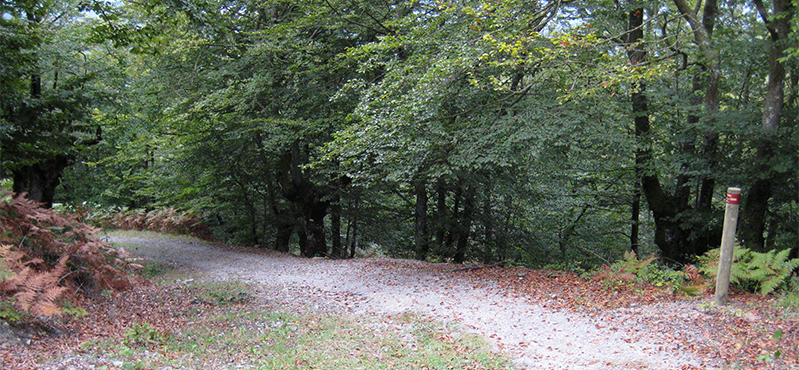
This stage begins in the car park located in the Arlaban pass. In order to set off on the trail, you need to cross the GI-627 highway, follow the road that heads towards Leintz-Gatzaga and immediately turn left along an asphalted lane that leads to a rural accommodation facility. On taking the first intersection to the left, you will come to a gently climbing forest track along which, after crossing beech groves and conifer plantations (radiata pine —Pinus radiata— and Lawson false cyprus—Chamaecyparis lawsoniana —) and following the signposts and passing under power lines, you will come to Mount Maroto, at kilometre point 3.5.
From this point onwards, you continue along a gravel and dirt forest track, first crossing a small beech grove, and then continuing among conifer plantations, covering some two kilometres across the mountain range’s high area. On reaching a fork in the trail, turn left, descending towards a beech grove and leaving Mount Jacinto to your right. Ahead of them, excursionists will see the region of Zuia, which belongs to the province of Araba/Álava.

For 2.5 km, the trail zigzags down a slight slope, crossing pasture areas and wooded meadows containing beech trees and thickets. On the descent, you can contemplate, at the bottom, Mount Gorbea, which the Trail heads towards in a successive stage. On reaching an area of pine trees, you have to take a very pronounced turning along a forest track that crosses the Pagola stream and continues gently downwards for two kilometres, crossing beech and oak forests and bordering the Albina reservoir to the south.
On following this route, immediately after crossing the Albina stream, which originates in the eponymous reservoir, you come to a crossroads.
To your left, some 500 m away, there lies the town of Legutiano on the banks of the Urrunaga reservoir. To your right, the “Senda del Pastoreo” continues; firstly climbing a small hill and then running along forest tracks that cross conifer plantations, mainly Scots pine (Pinus sylvestris), and bordering the Albina reservoir, which is often very nearby.

Following the path’s marks and signs, the trail crosses the A-2620 highway at one point, and continues, now at a distance from the reservoir, along dirt and gravel forest tracks for some 5.5 km until it comes to the town of Ortola. This route crosses an extensive forest area, mainly covered with beech trees and some pine stands, the latter in the vicinity of Ortola.
Here, you take the BI-2511 highway, which crosses the town and leads to the next one known as Olaeta. Both towns, with their surrounding meadowlands, are situated on an element considered to be of geological interest called the “Lomas del Arroyo de Ortola” or the “Hills of Ortola Stream”.
From Olaeta, the Trail runs parallel to the “Escarpes de Arangio” or the Escarpments of Arangio, which can be seen on the right, forming part of the Urkiola Natural Park. On passing through this town, you continue along the same road northwards, for some two kilometres, among meadows and farmhouses scattered on either side. Behind the forest house, you have to take a diversion to the left.

From the forest house turning, the Trail continues its easy 3.5 km ascent to Mounts Ollargain and Marsasu, along forest tracks among beech and pine trees. At this point, you enter the Urkiola Natural Park and the Site of Community Importance, to then descend at the same pace among beech and pine trees and pastures across the sides of the Urkiolaguirre peak as far as the Urkiola Pass, the end of the stage.
When you reach Urkiola, you can already see some of the limestone outcrops that led it to its declaration as a Natural Park, shaping an extremely beautiful landscape. Some of these limestone outcrops are considered to be of geological interest, for example, the “Cresterías del Anboto”, which lie to the right (northwards) of the path, housing peaks such as the Anboto (1.331 m), which lends it its name, and the Aitlluitz (1.034 m), among others. Also worthy of mention is the geological interest of the Valley of Mendiola, located at the foot of these outcrops.
On reaching Urkiola, you cross a park, which is outfitted with a rest area, children’s games, car park, etc., and is immediately followed by the Urkiola Sanctuary. This is an unfinished neo-mediaeval style building, consecrated in 1933, where mothers offered up their children of under a year old to San Antonio after spending a night in the sanctuary.
On following the road, you come to the town of Urkiola, located at the foot of the road to the Urkiola pass, which links Vitoria–Gasteiz to Bizkaia, through Durango. The second stage ends at this point.
EThis stage is suitable for cyclists as it runs entirely along tracks, without any steep slopes, although occasionally, depending on the time of year, you may have to walk in order to cross muddy areas.